
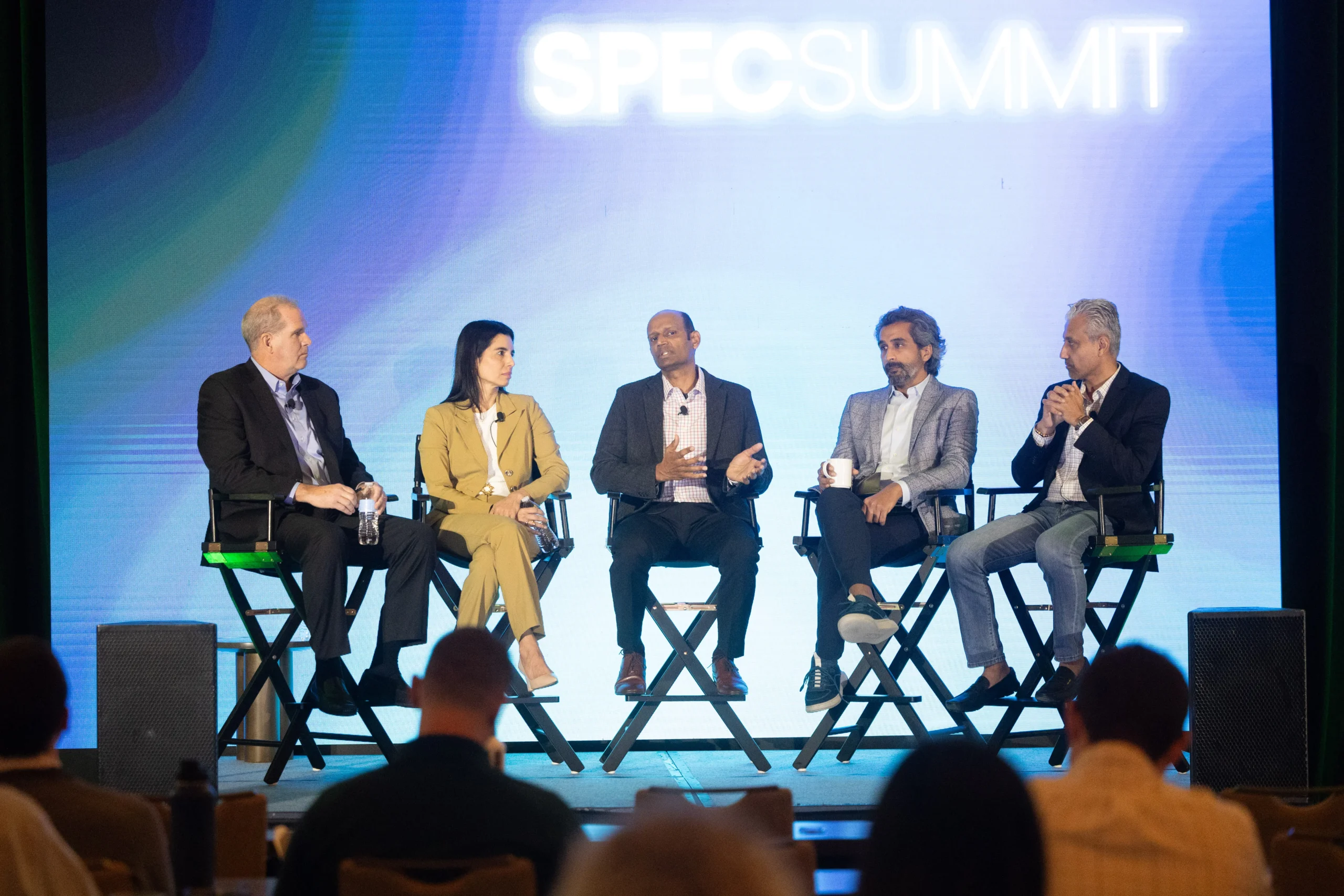
Note: This blog was drafted off of insights from the Spec Summit 2026 AI Panel on Product Development & Supply Chain Operations
Featuring: Claudia Barrera (Colgate-Pamolive) • Sriram Venkataraman (Former PepsiCo. R&D Leader, Consultant) • Prateek Lal (Adept Packaging) • Ayman Shoukry (Specright CTO) | Moderated by Mike Crowe (Retired CIO, Industry Advisory)
The conversation around AI in consumer packaged goods has too often been a tale of two extremes: breathless excitement on one side, paralysis on the other. At this year’s Spec Summit, I joined a panel of seasoned CPG, IT, and Packaging leaders, to discuss AI – not just the hype, but how to make it actionable. The panel delivered something rarer than a keynote prediction—they delivered specific proof points and use cases.
What follows is a synthesis of the panel’s most actionable insights, organized around the three questions every CPG operator is quietly asking: Where do I actually start? What does it take to build a foundation that lasts? And how do I scale before my competitors do?
The Gap Between Ambition and Practice—And Why It’s Closing
The panel opened with a candid assessment of where most organizations actually stand. A live audience poll found that 53% of attendees described their companies as “not very mature” in AI adoption—and only 13% reported using AI capabilities broadly across their teams.
No one on the panel was surprised. “There is the ambition and narrative that has a lot of excitement and hype to it,” said Sriram Venkataraman, who spent 24 years at PepsiCo before moving into consulting to help other CPG companies navigate the same transformation he led internally. “But there are also fairly limited practical use cases, at least in the CPG industry.”
The result, he added, is that clients are struggling not with whether to adopt AI—they know they must—but with where to start, when, and what to do first. It’s a genuine problem, and it has a practical answer.
Sriram’s recommended entry point: an organizational readiness assessment across three dimensions.
• Systems: What applications do you have, and how connected—or disconnected—are they?
• Data: What are your data repositories? How much is structured versus unstructured? How accessible is it?
• People: Do you have the skills in-house to embark on this journey, or will you need to rent, buy, or build them?
Four Focus Areas for AI in Packaging—Right Now
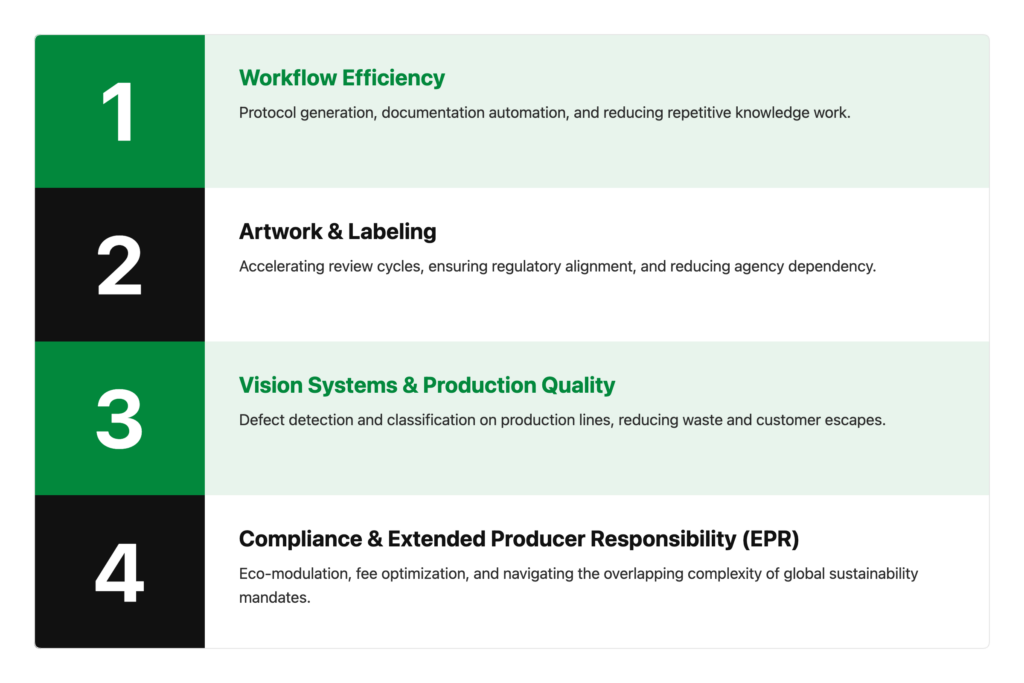
Prateek Lal, who has helped over 300 clients across nearly 20 years at Adept Group, offered a tighter frame for the packaging function specifically. When the top-down mandate comes down to “do something with AI”—but little more—these are the four areas he consistently recommends teams prioritize:
Real Numbers From Real Companies
The most powerful moments of the panel were when panelists stopped speaking hypothetically and started quoting results.
Colgate-Palmolive: From Downtime to Digital Twins
Claudia Barrera, Senior VP of Global Applications at Colgate-Palmolive, described a company that has moved well beyond AI pilots. She highlighted three concrete proof points:
• Predictive maintenance sensors deployed on plant machinery identified overheating early, saving approximately 192 hours of unplanned downtime and protecting the output of 2.8 million toothpaste tubes.
• AI-generated SOPs in local languages gave plant floor operators the ability to troubleshoot equipment issues independently, eliminating the need to bring in costly external specialists.
• Virtual consumer testing using digital twins accelerated innovation funnels by 6× to 10×—while also reducing agency costs for concept visualization.
PepsiCo: Compressing Three Months Into Hours
Sriram Venkataraman painted a picture of the traditional product development timeline that will resonate with any R&D or packaging professional: consumer testing rounds that span three months each, repeated iteration after iteration. Every cycle means shipping products to consumers across multiple geographies, waiting weeks for feedback, and synthesizing raw data before you can act.
AI changes the calculus entirely. Companies that have built intelligent engines on top of their accumulated historical testing data—data that, as Sriram noted, has typically been “sitting in documents and hard drives doing nothing”—are finding they can reach 80% of an optimal starting product formulation before a single consumer study is run. The final validation step still happens, but it’s validation, not discovery.
“Huge cycle time reduction—up to 50 to 60%—is what companies have seen. And on the supply chain side, AI-driven forecasting is improving accuracy by up to 30%, meaning less safety stock, less working capital, and better service levels.”
— Sriram Venkataraman, Former PepsiCo R&D Digital Transformation Lead
The Inconvenient Truth: Data is the Foundation
Every AI initiative in the room eventually arrived at the same unavoidable subject: data. Not in the abstract, aspirational sense that strategy decks invoke it—but as a genuine operational challenge that will determine whether any AI ambition succeeds or stalls.
Ayman Shoukry, CTO of Specright, was direct about what he observes most often: organizations rush to adopt AI, then discover mid-journey that their data isn’t accessible, isn’t governed, or simply isn’t clean. The disappointment that follows isn’t a technology problem. It’s a data problem—and it’s the number one reason AI adoption stalls.
Claudia Barrera described the infrastructure Colgate-Palmolive has built to address this head-on: designated data product owners, data stewardship roles accountable for accuracy and harmonization, a single source of truth to eliminate siloes, and a formal AI registry that tracks and approves every use case before deployment—a governance layer designed to prevent “shadow AI” from undermining trust.
She also underscored a principle that every panelist echoed in some form: humans must remain in the loop. At Colgate-Palmolive, no AI output is acted upon without employee review. It’s not a compliance checkbox—it’s embedded in the company’s practices. Accountability, they believe, cannot be delegated to an algorithm.
Sriram offered a memorable framing: “You can build all the fancy plumbing you want. If you don’t have clean water flowing through it, that plumbing is useless.” The clean water is data.
Scaling What Works: Structure, Governance, and Culture
Getting a proof of concept to work is one challenge. Scaling it across a global enterprise is another. Claudia shared Colgate-Palmolive’s operating model for doing exactly that—a model built on four pillars:
• Senior sponsorship: AI is explicitly endorsed and championed from the top of the organization, not delegated to IT.
• A cross-functional AI leadership team: Senior leaders from every division and function—including IT—shape strategy together.
• 250 AI Ambassadors globally: A distributed network of change agents who drive adoption, answer questions, and carry the cultural message into every corner of the organization.
• An AI-first process design mindset: Rather than retrofitting AI into legacy workflows, Colgate-Palmolive is identifying processes that should be redesigned from the ground up with AI as the architecture.
Sriram added three prerequisites for any organization attempting a multi-year AI transformation: unwavering top-down commitment, a capital planning approach that extends beyond the annual operating cycle, and clarity that AI is an enabler of business strategy—not a substitute for it.
“AI is not business strategy,” he said plainly. “I see that often confused.”
What to Do This Week (Not This Decade)
The panelists closed with a message of deliberate urgency. Yes, the work is hard. Yes, data readiness takes time. But the organizations that will lead in three years are the ones starting now—not waiting for a perfect moment that will never arrive.
Ayman Shoukry’s advice was perhaps the most clarifying of the session: stop thinking about AI as AI. Think about it as a how. What specific problem are you trying to solve? When you frame adoption through a problem lens rather than a technology mandate, measurement becomes natural—and results follow.
For those who feel behind, I offered this perspective: The competitive window is still open. And unlike the early days of ERP or cloud, there is now a rich ecosystem of partners—software platforms, consultants, and peer companies willing to benchmark—ready to accelerate the journey.
The ones who will look back with regret are not the ones who started imperfectly. They are the ones who waited for perfection.
You can watch the entirety of our Spec Summit panel here.
-

Mike Crowe
Mike Crowe served as Colgate-Palmolive’s Chief Information Officer for 9 years and spent a total of 34 years in Colgate before retiring at the end of 2022. As CIO, Mike forged many successful technology partnerships and elevated software development capabilities to support the Company’s broader strategic growth priorities while also strengthening Colgate’s financial discipline and efficiency model. Prior to joining Colgate, Mike was in the healthcare software industry working for Shared Medical Systems followed by Seton Hall University in support of the Health Corporation, Archdiocese of Newark. He also contributed to the development of the operating system for the US Aegis Naval Weapons System while working for Computer Sciences Corporation as an intern. Mike received his Bachelor of Science degree in Computer and Information Sciences from the University of Delaware, where he, and his wife Ellen, also created the Crowe Family Scholarship.
Currently, Crowe is an independent board member for Specright, Co-Chair for the Digital Supply Chain Institute within the Center for Global Enterprise, and an advisor to Trustmi, Sageview Capital and Cyberstarts. In early 2023, he co-founded Team Steve: The Steven Crowe Legacy Fund at Curesearch for Children’s Cancer along with his wife Ellen and their children, Matt, Patch and Becky.
Explore More Blogs
-

PPWR Compliance and The Data Silo Tax: What Fragmented Packaging Data Is Really Costing You
Read More → : PPWR Compliance and The Data Silo Tax: What Fragmented Packaging Data Is Really Costing You -

Beyond Compliance: Turning Packaging Data into a Business Advantage with Jessie Schwartz
Read More → : Beyond Compliance: Turning Packaging Data into a Business Advantage with Jessie Schwartz -

F&B PLM Is Finally Catching Up to How Products Actually Get Made
Read More → : F&B PLM Is Finally Catching Up to How Products Actually Get Made


Get Started
With Specright’s Solution Suite, you can digitize, centralize, and link your specification data to drive efficiencies, intelligence, traceability, and collaboration within your organization and across your supply chain network. For more information on this Product Release, contact your team.