EPR regulations are multiplying fast, and the cost of inaccurate packaging data is high. Specright gives brands and manufacturers the data foundation they need to stay ahead of compliance, reduce fee exposure, and scale reporting as regulations evolve.
There are over 130 EPR laws across 33 U.S. states and 500+ schemes globally—with more on the way. Extended Producer Responsibility (EPR) shifts end-of-life responsibility for packaging away from municipalities and consumers back to producers: brands, manufacturers, and importers.
Companies must collect, manage, and report detailed data on materials, packaging volumes, lifecycle impacts, and end-of-life outcomes across their entire supply chains.
Beyond the U.S., regulations like the EU’s Packaging and Packaging Waste Regulation (PPWR) are setting strict new standards for recyclability, recycled content, and sustainability reporting.
The cost of non-compliance is not abstract. EPR violations carry significant penalties by state, with the root cause in nearly every case being inaccurate or incomplete spec data:
California: Up to $50,000 in penalties per day, plus the potential for private legal action and removal of non-compliant packaging from the market
Oregon: Up to $25,000 in penalties per day
Colorado: Initial penalty of $5,000 for first day + $1,500/day for each day after
Minnesota: Up to $25,000 in penalties per day
Maine: Prohibition of sales in the state; public listing of non-compliant producers
Washington: Up to $1,000 per violation per day, escalating to $10,000 per day for repeat offenses
Maryland: Tiered penalties starting at $5,000 for a first violation, $10,000 for a second, and $20,000 for subsequent violations
The EPR Data Challenge
Most EPR compliance failures trace back to the same root problem: packaging data scattered across spreadsheets, emails, and disconnected systems. When regulations change teams scramble to pull together data that should already be structured, centralized, and audit-ready.
Challenges Companies Face
How Specright Helps
Vast Data Collection — Collecting packaging data across a wide vendor network is difficult without standardized systems.
Integrating Data with Existing Systems — Connecting EPR data to ERP, PLM, and CRM systems requires time and precision that’s hard to allocate.
Seamless Integration — Specright integrates with your existing systems so data is EPR-ready, supports new product development, and drives sustainable change.
Regulatory Deadlines & Multistate Compliance — Varying deadlines and reporting requirements across U.S. states and international markets create compounding complexity.
Proactive Deadline Management — Specright helps teams manage changing regulatory deadlines proactively. Structured data scales as new requirements come into force.
Vendor Onboarding and Management — Ongoing regulatory alignment with suppliers is necessary but time-consuming.
Streamlined Vendor Onboarding — Specright simplifies vendor alignment via workflows and a supplier portal, making it easy to collect and verify packaging data across your network.
EPR in Action
With Specright, you can ensure critical EPR supply chain data requirements are being tracked and validated, so as requirements grow, your compliance can easily scale.
“When I think of how Specright helps with EPR, sustainability, and compliance, two words come to mind: trust and speed. Because our data, which used to be fragmented, is now in a single place, and we’ve done the work to vet our spec data, we have a level of trust that lets us make decisions and report on that data with confidence and speed, because we can access it quickly.”
Anthony Knighten
Former VP of Technology, tms
Sugar Foods: Sweetening Sustainable Innovation with Specification Management
Sugar Foods Corporation manufactures sugars, sweeteners, salad toppings, and snacks across five U.S. and Mexico locations — but their packaging data was scattered across six disconnected systems with no single source of truth.
The breaking point came when a key supplier refused to keep working with them. Overnight, the team faced migrating 3,000 SKUs, 10,000 ship-tos, and 500+ customer labels. They turned to Specright.
Today, Sugar Foods has a centralized data foundation and streamlined approvals — freeing the team to focus on innovation and sustainable packaging instead of hunting down files.
Specright + Lorax: EPR Compliance Starts with Data
EPR compliance requires two things working in parallel: accurate, structured packaging data and deep regulatory expertise to turn that data into compliant reports.
Specright handles the data foundation. Lorax EPI, the leader in EPR reporting, handles the regulatory complexity. Together, this partnership offers an end-to-end solution for EPR readiness.
Digitizes and centralizes packaging spec data: material type, weight, recyclability, and more
Enables vendors to input or verify data via supplier portal
Identifies and fills data gaps for EPR readiness
Serves as system of record for all packaging impact data
Scales EPR readiness for future regions and recurring reports
Lorax EPI
Interprets EPR legislation and advises on policy (in/out of scope, exclusions)
Calculates fees based on local legislation and region-specific material categories
Generates EPR reports for submission to PROs and national registries
Benchmarks EPR performance and optimizes submissions
Constantly researches and updates guidance for new regions and schemes
“Through our partnership with Specright, companies can focus on the data requirements and have confidence that what they’re reporting is comprehensive and accurate.”
Michelle Carvell
COO, Lorax EPI
Streamlining EPR Reporting through Collaboration
Specright created the Sustainable Packaging Data Council (SPDC), uniting leading brands, retailers, technology partners, nonprofits, and academia around one shared mission: to standardize packaging data and make EPR compliance scalable.
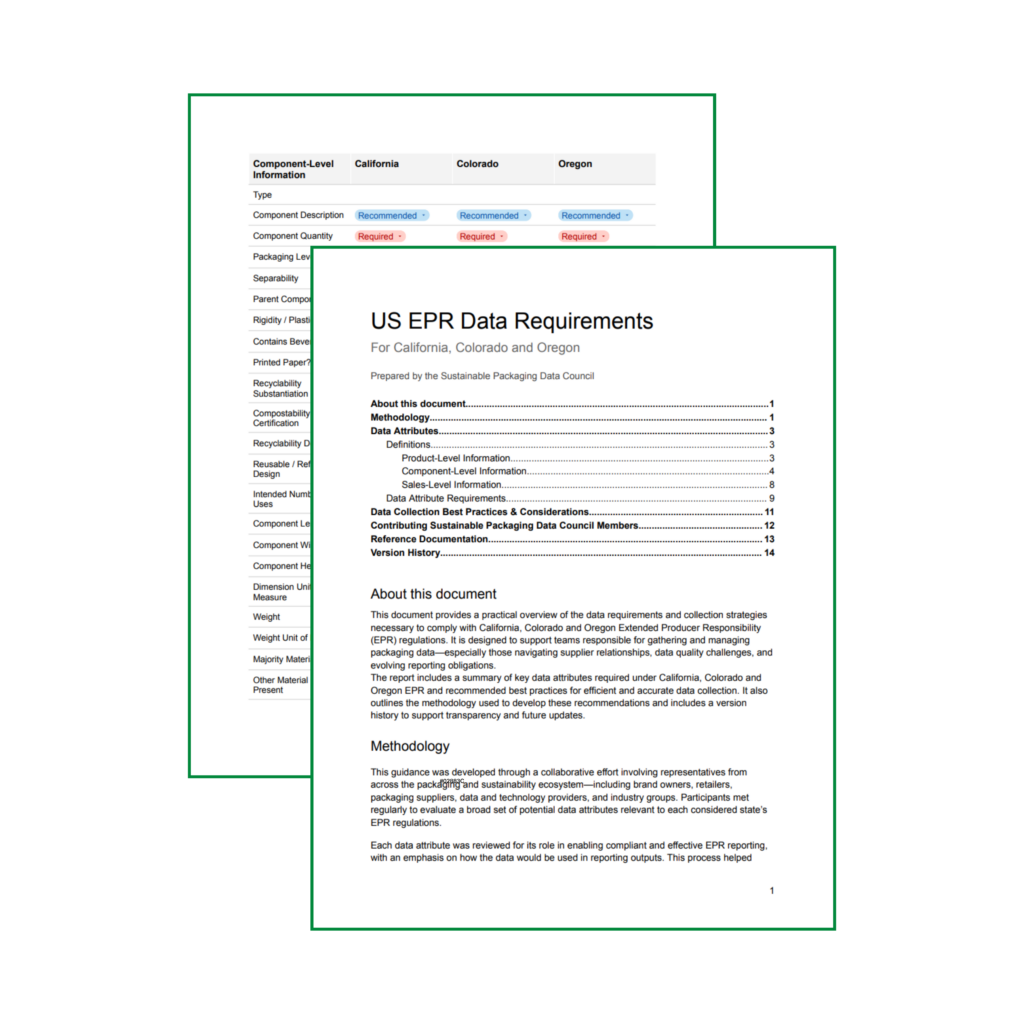
As EPR legislation expands rapidly across the U.S.—and global regulations like the EU’s PPWR set new data requirements—the SPDC has developed a standardized U.S. EPR data requirements framework to answer a simple but critical question: what data does your team actually need to collect, and in what format?
The result is a free, practical guidance template built on cross-industry collaboration—designed to get your team EPR-ready without starting from scratch.
With 5 million+ products on Specright’s Specification Data Management (SDM) platform, we’re helping some of the world’s largest companies and challenger brands optimize costs, accelerate innovation, and reduce waste. See how you can join the Specification Management movement — we’ll start with a brief call to understand your goals and then schedule a tailored demo experience that fits your needs.