You want to know which platform fits how your products are built, not just how your supplier documents are stored. While TraceGains excels as a document-first supplier compliance network, Specright’s approach focuses on spec-first engineering for consumer products. Instead of tracking static PDFs, our platform structures your data at the component level to tie formulas, packaging, and suppliers together.
The proof is in our platform architecture. Specright manages over 5 million products on a patented Specification Data Management™ (SDM) foundation, delivering a 94% customer retention rate and a 300% plus average return on intelligent specification management.
TraceGains is highly effective for companies prioritizing an established food and beverage supplier compliance network. Meanwhile, Specright is engineered from the component level up to handle specification-first, enterprise-grade product and packaging data across multiple sectors.
The market feedback matches this design. On G2’s Specright vs TraceGains comparison, reviewers rate Specright higher for ease of use, ease of setup, and quality of support, giving Specright 4.5 out of 5 stars compared to TraceGains’ 4.1 stars (as of July 2026).
Here is how the two platforms compare on what matters to a consumer-products team.
Dimension
Specright
TraceGains
Core Focus
Specification Data Management (SDM), the spec-first system of record, with PLM built on the data foundation
A networked supplier compliance and document exchange platform, with packaging spec management (PackMan) added in 2026
Built For
Food and beverage, beauty, fast-moving consumer goods, packaging, industrials, and life sciences
Food and beverage, CPG, and dietary supplements, with secondary pet food, pharma, and personal care
Data Model
Patented SpecGraph, a many-to-many model that structures specs to the component level
Document and questionnaire-driven, centralizing supplier files and COAs, with packaging specs managed separately through its PackMan module
Platform and integrations
Open, API-first architecture, click-not-code and configurable by business users without IT, with pre-built connectors and integrations to ERP and PLM systems including SAP and Oracle
Networked SaaS with native digital-artwork integration via Esko WebCenter Go and AI document processing (IDP) for supplier COAs
Supplier network
Configured per customer, with suppliers entering data directly into the platform
A large pre-existing supplier network, a genuine TraceGains strength for fast supplier onboarding
AI Approach
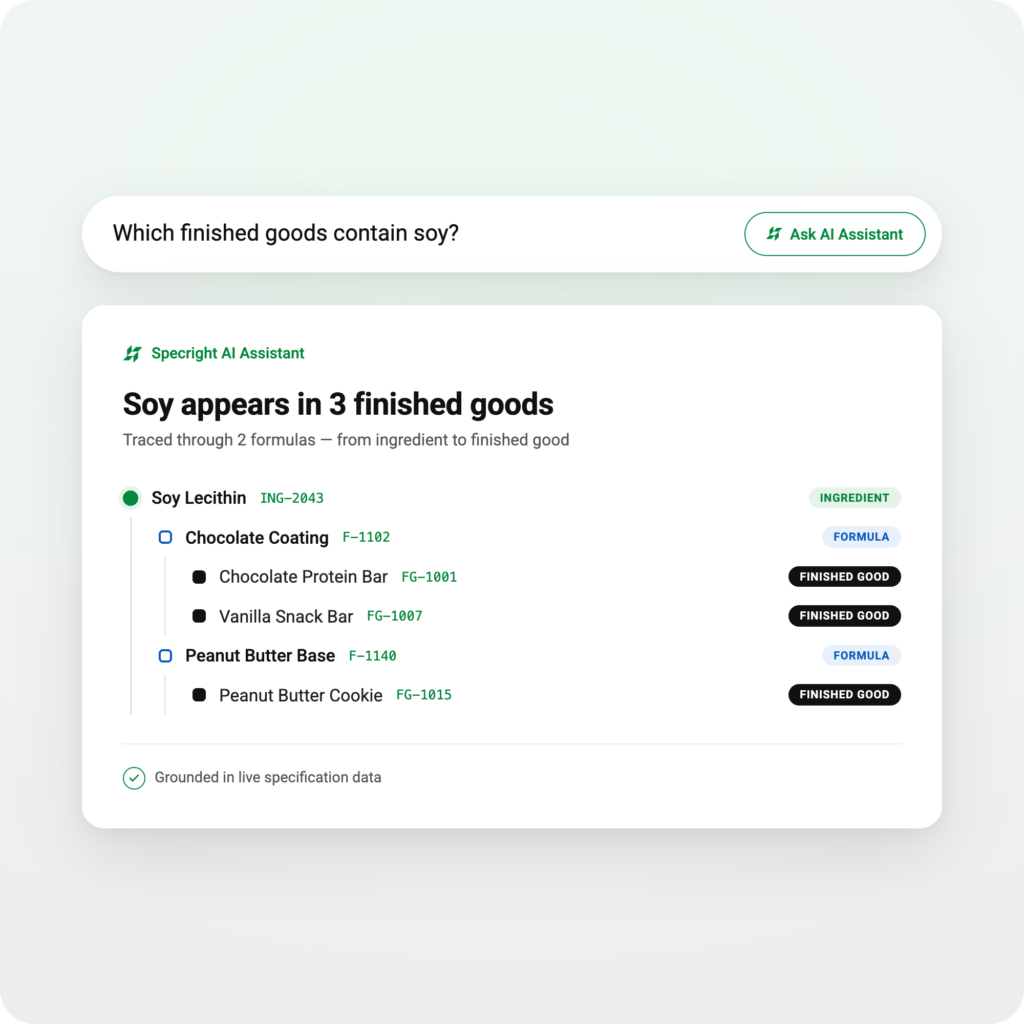
AI grounded in your spec data, AI-assisted formulation (R&D Workbench), Specright AI Assistant, and document processing
AI for COA and document processing (IDP), supplier risk monitoring, and regulatory intelligence
Sustainability and Extended Producer Responsibility (EPR)
Native packaging engineering with automated state EPR and EU PPWR report generation via Lorax
Ingredient-level Scope 3 carbon reporting via Carbon Insights (DitchCarbon and Sustained)
Total cost of ownership
Modular, start with your most critical data and scale
Enterprise, quote-based, with full packaging artwork capability running through a separate Esko WebCenter Go integration
Where Specright Wins
Spec-first data, not document storage
Specright structures every detail on the patented SpecGraph, turning small details like dimensions, flute types, and recycled content into searchable digital data.
TraceGains organizes supplier paperwork and COAs, but its fragmented questionnaire process for product specifications burdens suppliers and can lead to organizational errors.
Centric is an open sandbox that relies on customers to define and document their own processes, which users report can drive long, costly, multi-year implementations.
TraceGains remains largely limited to food, beverage, and nutritional supplements.
Brands That Run on Specright
Ancient Nutrition, a whole-food supplements brand, broke down internal data silos by transitioning to our platform. By centralizing raw materials and packaging specs, the team established automated quality workflows to track and resolve non-conformance issues.
The strategy led to immediate operational improvements, reducing a major broken-seal packaging defect from 700 incidents down to fewer than 250.
“Having broken-seal data in real-time and being able to link these complaints to a specific supplier at the time that they were created, really helped us dive in and find the root cause and where the problems were happening…And the reporting accessibility has saved me anywhere from hours to days.”
Tracey DeBee
Quality Manager, Ancient Nutrition
See It on Your Own Data
The path forward begins with your specific products. We start with a brief call to understand your business goals, then walk through Specright using your own packaging and product data. This allows you to evaluate the platform on your terms, testing our spec-first architecture against your current workflows.
What is the difference between Specright and TraceGains?
Specright is a spec-first Specification Data Management platform built for the formulas, ingredients, and packaging behind consumer products, with PLM built on that data foundation. TraceGains functions as a networked supplier compliance and document exchange platform for food and beverage that added packaging specification management in 2026.
Does TraceGains do packaging specification management?
Yes. TraceGains launched PackMan in 2026 for packaging specifications, assembly hierarchies, and artwork change control, with full artwork management running through a separate Esko WebCenter Go integration. Specright handles packaging spec data natively, using built-in engineering tools and a component-level data model.
How much do Specright and TraceGains cost?
Both are enterprise, quote-based platforms without public pricing. Specright pricing is modular, allowing you to start with your most critical data and scale as you grow. You can see a tailored quote by booking a platform demo.
Is Specright a good TraceGains alternative for companies outside food and beverage?
Specright serves packaging, beauty, CPG, pharma, and industrial brands on a single data model, whereas TraceGains’ customer base and schemas concentrate heavily in food, beverage, and dietary supplements. For multi-category brands, Specright manages every product line without requiring parallel software tools.
Which platform is better for FSMA 204 compliance?
TraceGains addresses FSMA 204 compliance through its network and its specific February 2026 partnership with iFoodDS, making it a strong choice for food safety document routing. Specright solves FSMA 204 compliance from the ground up by tracing the physical lot data of ingredients and packaging components back to the exact specification, ensuring complete supply chain traceability.
Is Specright a good TraceGains alternative for companies outside food and beverage?
Specright serves packaging, beauty, CPG, pharma, and industrial brands on a single data model, whereas TraceGains’ customer base and schemas concentrate heavily in food, beverage, and dietary supplements. For multi-category brands, Specright manages every product line without requiring parallel software tools.
Specright enables you to drive intelligence, traceability, and collaboration within your organization and across your supply chain by transforming siloed, disjointed specification information into a single source of truth, with invaluable real-time data streams that accelerate nearly every supply chain effort.
With 5 million+ products on Specright’s Specification Data Management (SDM) platform, we’re helping some of the world’s largest companies and challenger brands optimize costs, accelerate innovation, and reduce waste. See how you can join the Specification Management movement — we’ll start with a brief call to understand your goals and then schedule a tailored demo experience that fits your needs.