

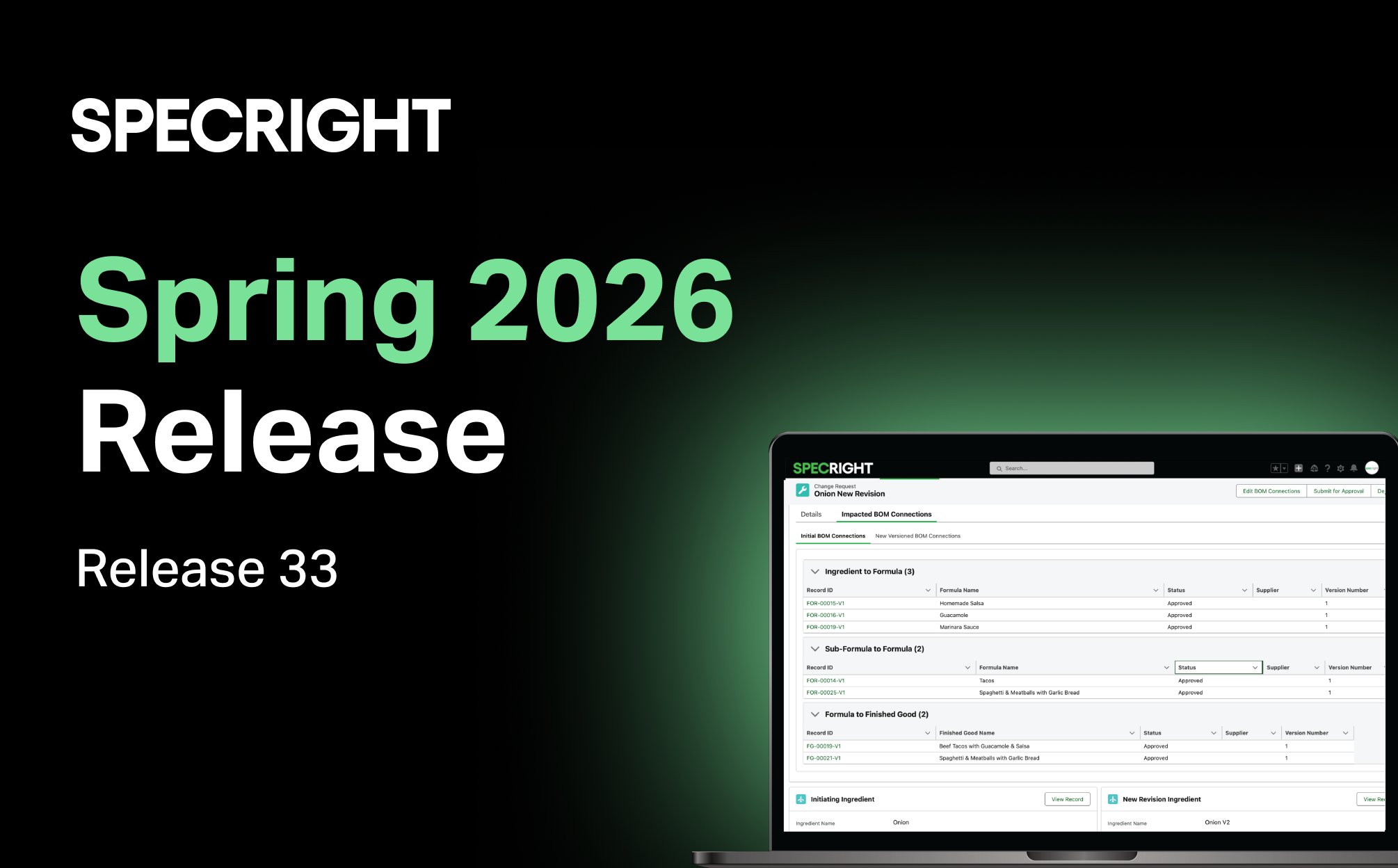
At Spec Summit 2026, we shared a bold direction for where Specright is headed: an AI-driven, spec-first PLM. With the Spring 2026 product release, we continue to deliver on that vision.
Specright’s AI Assistant brings natural language querying to every screen in Specright — helping your team put intelligence to work anywhere your data meets a decision. This product release also marks the GA of the R&D Workbench for Food & Beverage — a purpose-built environment for F&B formulation and development teams.
But this release goes beyond AI. Release 33 focuses on reducing friction between your data and the decisions that depend on it. It features custom compliance rules that enforce retailer mandates and internal sustainability policies. In addition, structured project briefs are also included to give new product initiatives a defined starting point.
Here’s a look at the highlights.
Your Spec Data, On Demand — Specright AI Assistant Is Here
Users can continue to work in Specright by navigating the dashboard, applying filters, running reports and leveraging the navigation that they are familiar with, or as of this release, they can switch to Specright AI Assistant.
Specright AI Assistant is built directly into Specright and accessible from any screen via a persistent utility bar. Ask a question in plain English — “How many packaging specs do I have in draft status?” or “Find everything related to aluminum foil across my specs and ingredients” — and get an answer instantly, without leaving your workflow.
For teams managing large specification libraries, the impact is immediate. Data that previously required navigation expertise or a report request is now one question away.
For IT and compliance-conscious organizations, Specright AI Assistant is built to enterprise standards. Every action is captured in an immutable audit log and AI Assistant inherits each user’s existing Specright permissions. Users only ever see data they’re already authorized to access. There’s no separate login, no new application to adopt, and no data leaving your environment.
The R&D Workbench Comes to Food & Beverage
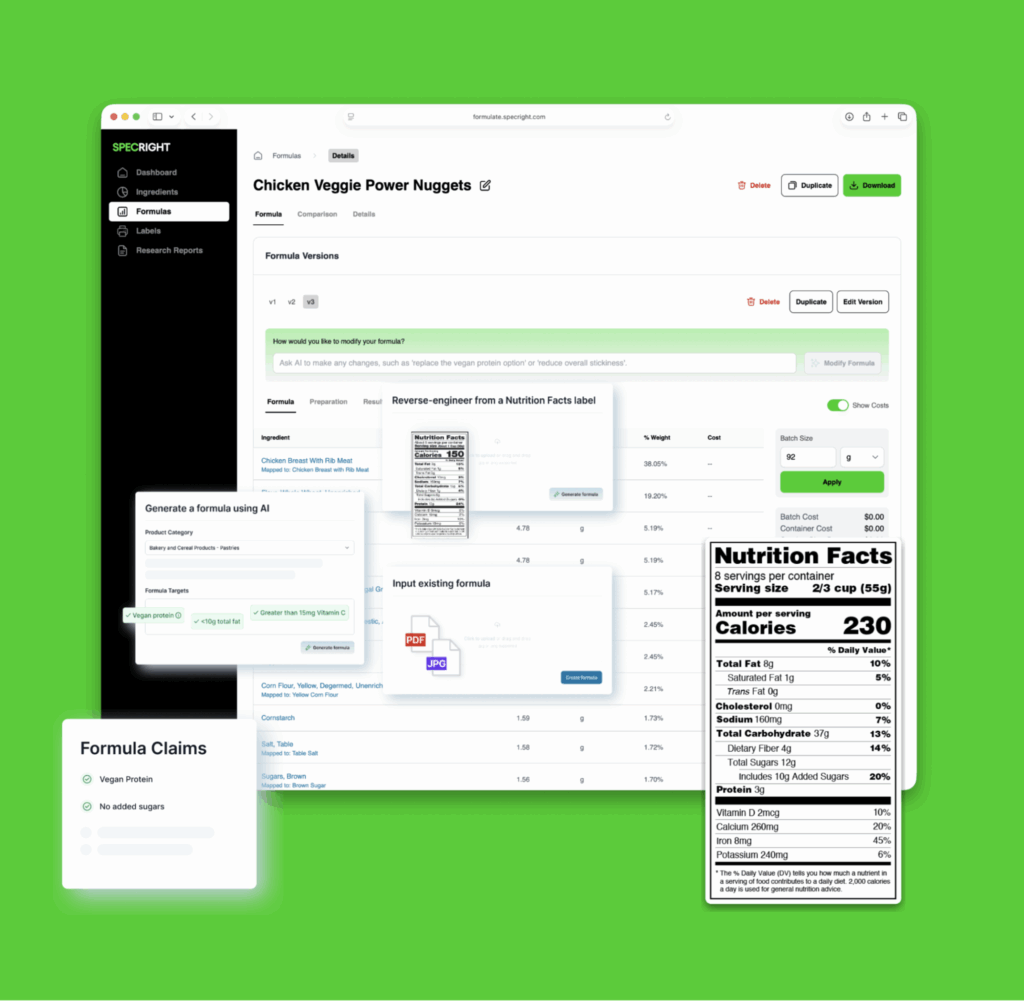
For F&B R&D teams, formulation work has long meant stitching together spreadsheets, manual compliance checks, and disconnected tools — a process that consumes scientific talent and introduces real risk, especially for brands operating across multiple regulatory jurisdictions. Spring 2026 marks the GA of our first R&D Workbench, purpose-built for Food & Beverage and grounded in Specright’s spec-first data architecture.
The Workbench gives formulators an AI-native environment to create and iterate on formulas. Users can start from scratch or reverse-engineer existing products with intelligent substitution suggestions — with full version history and rationale capture across every change. Built-in nutrition analysis feeds compliant label generation across the US, Canada, Mexico, EU, and UK, while claims verification validates nutrient and health claims against FDA, USDA, Health Canada, NOM-051, and EU/UK frameworks. Allergen data flows automatically from ingredient records through formulas and labels, with emphasis flagging that meets US, EU, and UK declaration requirements.
For formulators, that means less time chasing regulatory references and more time on the science. The R&D Workbench for F&B is the first of three workbenches launching this year; stay tuned for what’s coming next.
Compliance That Goes Beyond the Rulebook
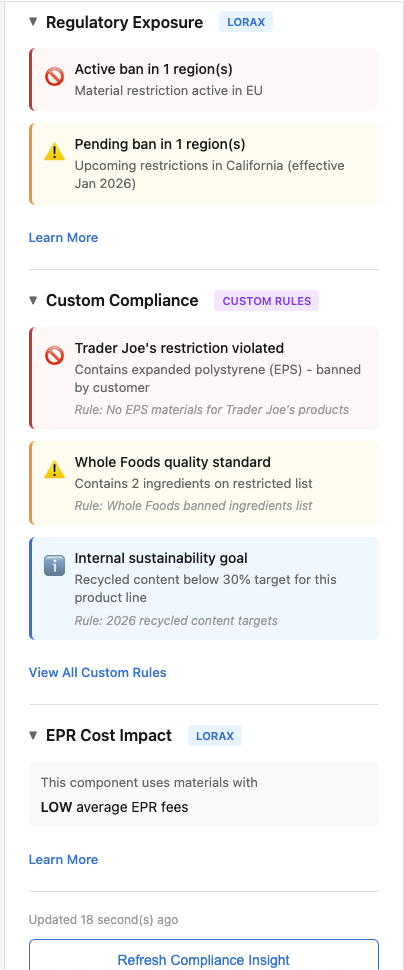
Specright’s existing Compliance Insights capability — built in partnership with Lorax — already helps teams surface regulatory risks like EPR fees and state-level material bans directly on packaging component records. Spring 2026 extends that foundation with Custom Compliance Rules, giving brands the ability to define and enforce their own compliance criteria alongside government regulations.
That means you can now track specifications against retailer-specific material restrictions — like a major natural grocery chain’s ban on expanded polystyrene — alongside your own internal sustainability policies, such as a target to keep plastic content below 10% across a product line. Like standard Compliance Insights, custom rules run directly on packaging component records, so the analysis is always in context, not in a separate tool or spreadsheet.
For sustainability directors and compliance teams, this fills a real gap. Regulatory requirements are only part of the compliance picture. Retailer mandates and internal policies carry just as much operational risk — and until now, tracking them required manual review. Custom Compliance Rules lets you validate your entire portfolio automatically, and catch issues before they reach the dock.
A Better Starting Point for New Product Development
Kicking off a new product initiative in Specright just got more structured. For example, Release 33 introduces Project Briefs — a dedicated brief capability within the Project Management (formerly named NPD) module that gives teams a defined starting point for new initiatives, complete with out-of-the-box templates. This marks a significant product release, enhancing workflow efficiency.
Templates ship for the three most common workflows: core innovation, product innovation, and product renovation. Instead of starting from a blank record or recreating context that lives in someone’s inbox, teams now have a structured, consistent format for capturing what a project is, what it needs to accomplish, and how it aligns with business objectives — from day one.
INCI Support for Personal Care Formulation
For CPG and personal care customers, formulation work has its own language — and Spring 2026 adds support for it. The Batch Calculator now includes INCI (International Nomenclature of Cosmetic Ingredients) support, bringing industry-standard ingredient naming into Specright’s formulation workflows. This upgrade is part of the evolving product release lineup within the platform.
For teams that have been working around the absence of INCI support, this removes a meaningful friction point. Formulas can now reference and calculate against INCI nomenclature natively, without manual translation or workarounds outside the platform.
And There’s More
Release 33 also includes significant updates across several other areas. The Spec Grid Enhanced Data Grid introduces inline editing and mass update capabilities. With these, teams can modify spec records in bulk without opening individual records. This provides a meaningful time savings for anyone managing large datasets. Mass Revision Logic adds a major/minor revision toggle. As a result, teams get a cleaner way to distinguish between changes that require full approval workflows. They also get a simpler way to handle minor updates that don’t. And Spec Export receives a round of feature parity improvements. These include custom messaging, header/footer controls, file attachment handling, and support for multiple child templates. Notably, these updates will particularly benefit teams migrated from legacy systems.
As always, new features require the latest version of Specright. Reach out to your Specright team to learn more.
-

Karthik Rajagopal
Karthik Rajagopal is the Chief Product Officer at Specright, where he leads product strategy and innovation. With over 25 years of experience in enterprise software, Karthik is passionate about delivering customer value through innovative solutions that are intuitive to adopt and use. He brings a value generation mindset to product innovation, ensuring solutions solve real business problems for large and small enterprises across diverse industries. Most recently, Karthik was Executive Vice President of Product at FourKites, where he led a global product and UX team supporting 500+ enterprise customers. He launched agentic AI solutions that are now deployed and delivering value at large enterprises, demonstrating his belief in meaningful AI adoption that drives real results. Prior to FourKites, he held senior product and solutions leadership roles at GT Nexus (acquired by Infor), E2open, Viewlocity Technologies, and i2 Technologies (now Blue Yonder). Karthik holds a Master of Science in Industrial Engineering from the University of Cincinnati and a Bachelor of Technology in Mechanical Engineering from the Indian Institute of Technology, Madras.
Explore More Blogs
-

Spec-First. AI-Powered. See It Live at Pack Expo 2026.
Read More → : Spec-First. AI-Powered. See It Live at Pack Expo 2026. -
The Only Constant Is Change: What London Packaging Week Confirmed About UK pEPR, PPWR, and Packaging Data
Read More → : The Only Constant Is Change: What London Packaging Week Confirmed About UK pEPR, PPWR, and Packaging Data -

PPWR Compliance and The Data Silo Tax: What Fragmented Packaging Data Is Really Costing You
Read More → : PPWR Compliance and The Data Silo Tax: What Fragmented Packaging Data Is Really Costing You



Get Started
With Specright’s Solution Suite, you can digitize, centralize, and link your specification data to drive efficiencies, intelligence, traceability, and collaboration within your organization and across your supply chain network. For more information on this Product Release, contact your team.