


Packaging regulations are accelerating on every front, all at once. Extended producer responsibility (EPR) schemes, single-use plastics restrictions, recycled-content mandates, and deposit return systems are landing in different forms, on different timelines, in market after market. No two frameworks look alike, and none of them wait for the others to catch up.
PPWR compliance sits at the center of that shift. The EU Packaging and Packaging Waste Regulation (PPWR) is the first time every member state in a major economic bloc has agreed to run compliance on a single binding timeline. Substances of concern, Declarations of Conformity (DoC), recyclability grading, EPR reporting, labelling — each requirement lands on its own date, but every one of them draws on the same underlying resource: accurate, structured packaging specification data.
That is exactly where most organisations are exposed. Packaging specs still live across spreadsheets, supplier PDFs, shared drives, portals, and email threads. Fragmented data does not show up as a line item on any budget. Yet, it gets paid anyway, quietly, in time, money, risk, and lost opportunity. We refer to this as the “data silo tax.”
Where the PPWR Compliance Tax Gets Charged
Specification data breaks down in three predictable places. Brands, business units, plants, and regions across the enterprise each take the approved specification and adapt it to their own needs, so the single source of truth quietly fragments into several, creating a “version gap.” Across functions–packaging, procurement, quality, sustainability, and regulatory–teams each extract the data they need to make different decisions, often from different points in time, creating an “evidence gap.” Across suppliers, tier-one and tier-two partners return information as PDFs, spreadsheets, portal exports, and emails, so the technical documentation a DoC requires ends up scattered across formats nobody owns, creating a “context gap.”
The data silo tax comes due in four places:
- Time: Before adopting a spec-first system of record, organisations report spending an average of nine working weeks a year compiling and submitting sustainability and regulatory reports — chasing evidence, reconciling versions, and re-keying figures that should already exist.
- Money: According to Forrester, poor data quality costs the average business more than $5 million a year, with 7% reporting losses of $25 million or more. Depending on your company size, you could land below or above this average.
- Risk: Claims that cannot be evidenced, compliance findings that cannot be defended, and the reputational cost of a gap between what a business says and what it can prove.
- Lost opportunity: Without a portfolio-wide view, procurement cannot pursue economies of scale, and any AI or analytics layered on top of weak inputs simply produces confident guesswork faster.
Deadline Mode vs. Capability Mode: Why Reactive PPWR Compliance Costs More
Most organisations manage PPWR compliance in deadline mode: a request arrives, someone chases suppliers and emails, reconciles spreadsheets, submits a report, and calls it done, until the next request arrives and the cycle starts over. It is not a failure of the people doing the work. It is a process that was never designed to be reused.
The alternative is capability mode: capture the data and the evidence once, validate ownership and version control, link it to the approved specification, and reuse it every time a report, a market, or a regulation changes. The shift is not about working faster inside the same broken loop. It is about not rebuilding the foundation for every deadline that shows up. Four connected stages turn that shift into a repeatable system: Collect, Capture, Enhance, and Comply.
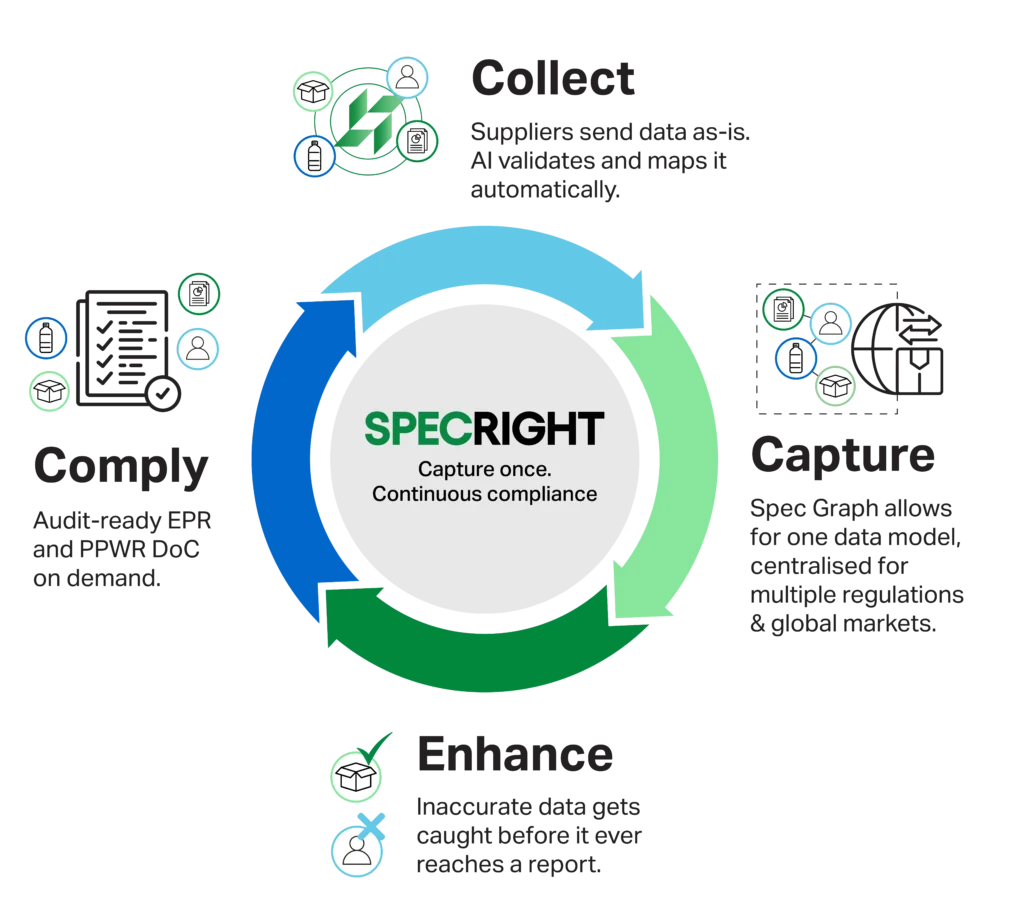
A Foundation Built to Scale: Collect, Capture, Enhance, Comply
Escaping deadline mode requires a data foundation built in four connected stages, not four separate projects.
Collect: Accelerate PPWR Supplier Data Collection
Compliance readiness is only ever as complete as the supplier data and documentation behind it, and collecting it across hundreds of suppliers is typically where PPWR readiness grinds to a halt. Removing the friction starts with letting suppliers submit data in whatever format they already use — no new templates required — while AI maps, validates, and confidence-scores every field against PPWR requirements automatically. Verified data flows straight into a central system, ready to support whatever reporting or documentation the next market or requirement demands.
Capture: Build a Single Source of Truth for Packaging Specification Data
Collecting the data once is not enough if it has nowhere structured to live. Every critical PPWR data point— a recyclability grade, a label, a substance of concern—hinges on granularity. Relying on static spreadsheets or supplier PDFs means rebuilding the database every time a requirement changes, with no guarantee that what gets produced still matches reality. A single system of record built on dynamic relationships solves this: component-level precision across every material type, weight, and recycled-content percentage PPWR requires, with data that rolls up automatically the moment a component spec updates — propagating to the finished-good level across every connected record, closing documentation gaps as they happen. That same foundation then powers the DoC, EPR reporting, eco-modulation calculations, and whatever requirement comes next. Built once, it gets reused across every deadline.
Enhance: Maintain Continuous PPWR Data Quality
A foundation is not something to set once and walk away from, it has to stay accurate as the regulation around it keeps shifting. A continuous data-quality layer scans every packaging spec against active PPWR requirements, catching missing material, weight, or recyclability data before it ever reaches a report or a regulator. By the time any requirement lands — a new market, a new deadline, an audit — the underlying data is already clean and current.
Comply: Deliver Audit-Ready Compliance on Demand
This is where the foundation pays off. Instead of exporting data to a separate tool, compliance documentation assembles natively from the spec data and evidence already on file, walking through PPWR article by article so it is clear exactly which requirements each packaging spec meets and where the gaps remain before anything is generated. Because it pulls from live spec data, documentation stays current — regenerating in a few clicks the moment a spec, supplier, or requirement changes, in the language of any market sold into. What used to be a months-long scramble becomes minutes.
The same foundation extends past the DoC. EPR reporting draws on the same verified dataset, centralising data collection and managing country-by-country deadlines rather than rebuilding a submission for each market, and replacing rounded weights and assumed material splits with actual component-level data has consistently translated into lower fees paid, not just faster filing. Eco-modulation goes a step further, using that same material and packaging data to weigh what a material choice costs in fees today against how an upcoming ban or grading change might shift that picture tomorrow, moving compliance from a reactive posture to a proactive design decision.
What the PPWR Compliance Foundation Is Worth
Organisations running on this model report a 44% reduction in time spent submitting sustainability reports and a 28% annual decrease in fees, penalties, and fines — because component-level data replaces estimation with fact. Visibility into sustainability metrics improves by as much as 40%.
The Takeaway
The data silo tax is not a one-off cost tied to a single regulation. It is a recurring charge on every deadline, every market, and every new requirement layered on top of the last — for as long as packaging data stays fragmented. Fixing the data flow once, and reusing it across Collect, Capture, Enhance, and Comply, is what turns PPWR compliance from a recurring scramble into a foundation that scales with whatever comes next.
If you want to learn more about this topic, check out our on-demand webinar or if you’re ready to see what a spec-first foundation looks like for your portfolio, talk to our team today.
-

Danielle Goad
Danielle Goad is the Director, EMEA at Specright, responsible for scaling the company’s presence across EMEA and working with global brands on specification-driven sustainability and compliance. Danielle has held roles across departments at Specright including Customer Success, Product, and Strategic Partnerships over her 7 years with the company. Prior to Specright, Danielle graduated from California Polytechnic State University – San Luis Obispo with her undergraduate in Industrial Technology and Packaging – focused on supply chain.
Explore More Blogs
-

PPWR Compliance and The Data Silo Tax: What Fragmented Packaging Data Is Really Costing You
Read More → : PPWR Compliance and The Data Silo Tax: What Fragmented Packaging Data Is Really Costing You -

Beyond Compliance: Turning Packaging Data into a Business Advantage with Jessie Schwartz
Read More → : Beyond Compliance: Turning Packaging Data into a Business Advantage with Jessie Schwartz -

F&B PLM Is Finally Catching Up to How Products Actually Get Made
Read More → : F&B PLM Is Finally Catching Up to How Products Actually Get Made


Get Started
With Specright’s Solution Suite, you can digitize, centralize, and link your specification data to drive efficiencies, intelligence, traceability, and collaboration within your organization and across your supply chain network.