

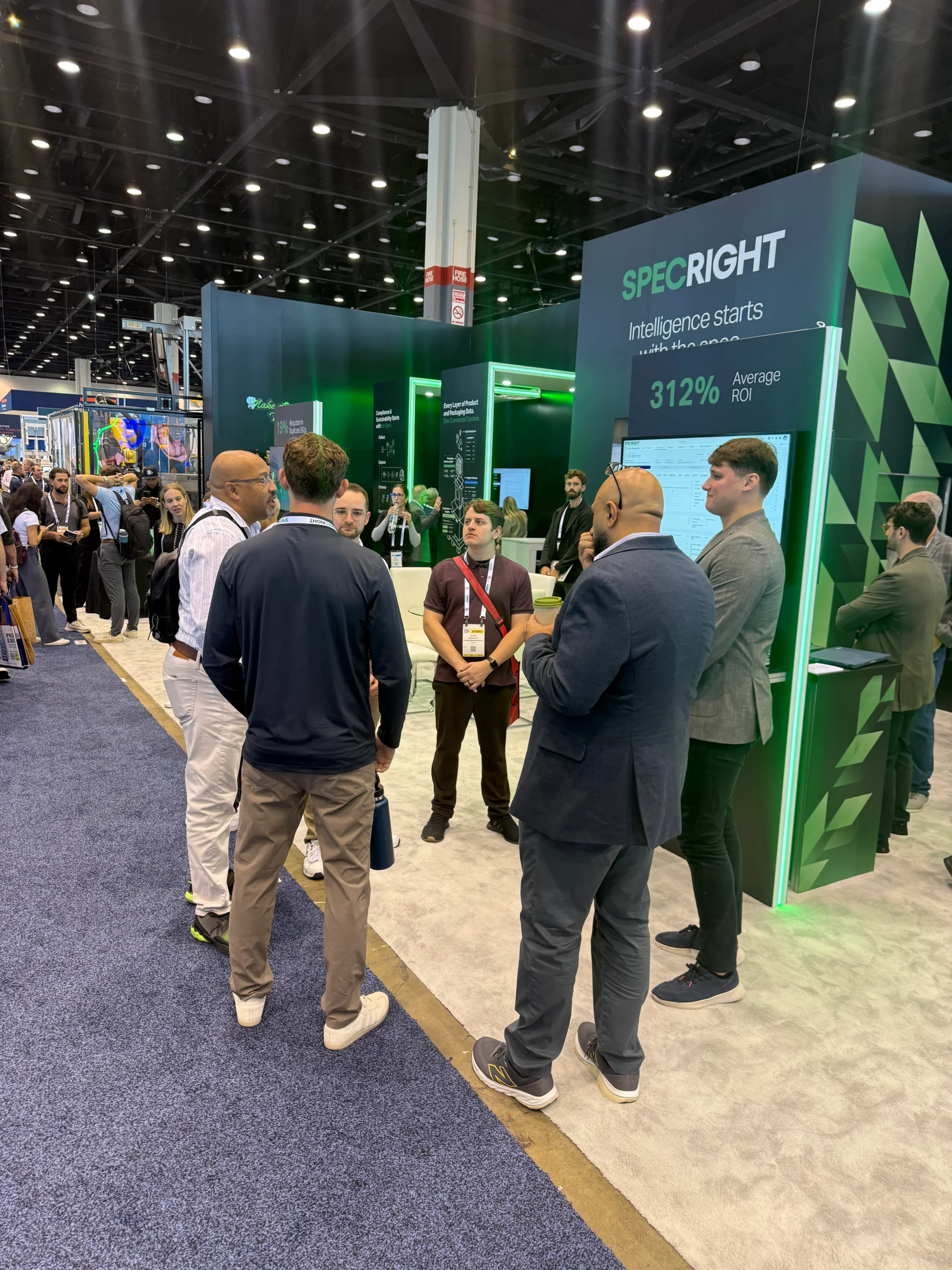
Pack Expo 2026 made one thing clear: packaging teams are being asked to do more with less, and spreadsheets can’t carry the load anymore.
More regulations. More SKUs. More supplier data to collect. The same size team, or smaller. Across four days in Chicago, the Specright team talked with packaging engineers, sustainability leaders, and procurement teams, and more, who carry that weight every day. The question has changed. It’s no longer “Should we use AI?” It’s “How do we put AI into action?”
Attendees came ready to act. Many arrived at the booth with concrete plans and specific requirements in hand. Whatever the industry, the spec data challenge looks the same.
The answer starts with the spec, but that’s also not where it stops.
Specright at Pack Expo 2026: Three Sessions, One Truth
Specright led three thought leadership sessions at Pack Expo 2026. Each took a different angle. All three landed in the same place: AI is only as good as the specification data underneath it.
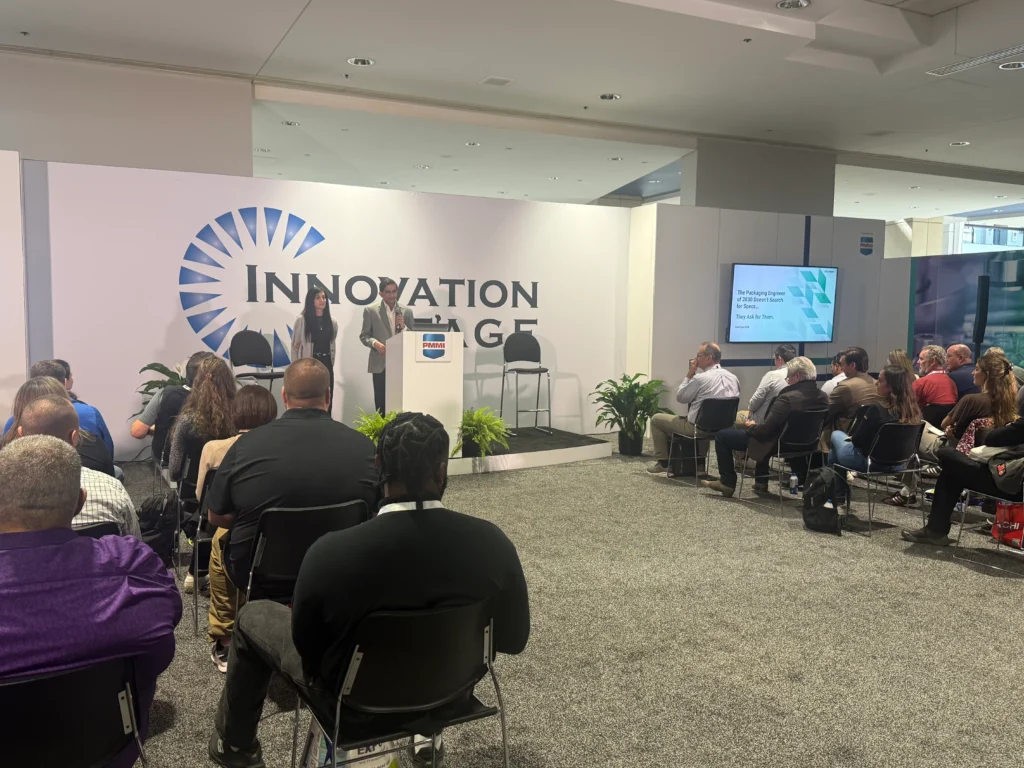
The Packaging Engineer of 2030 Doesn’t Search for Specs. They Ask for Them.
Karthik Rajagopal, Chief Product Officer, and Sunitha Nair, former packaging professional and Specright Partner Implementation Consultant
The best packaging engineers spend too much of their day on work that has nothing to do with engineering. Sunitha described being “the last point of contact” when something goes wrong on the line: digging through shared drives, disconnected systems, and supplier emails to find the right spec. Karthik showed how the Specright AI Assistant, Agents, and the Supplier Network give that time back, so engineers can get back to engineering.
Design for Compliance: How Spec-First Packaging Reduces EPR Fees and Regulatory Risk Before Products Launch
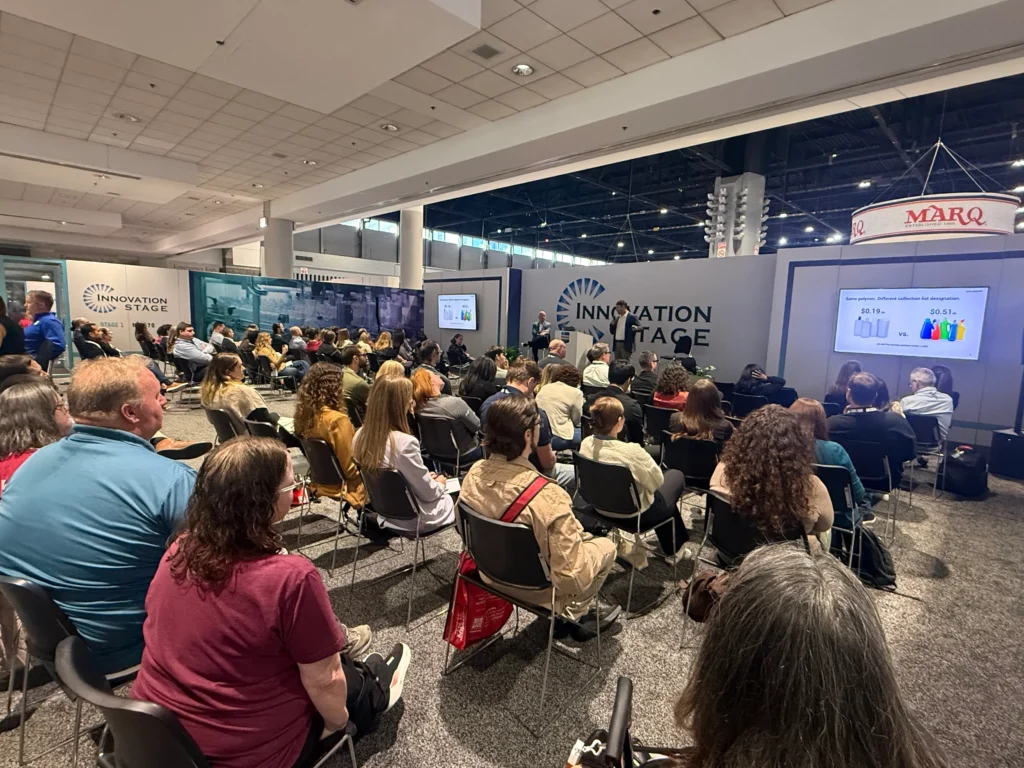
Matthew Wright, Specright Founder and Executive Chairman, and Matt Swenson, Board Member, Institute of Packaging Professionals
Matthew and Matt told the EPR story backwards from the future: start with where EPR fees are headed, then work back to the decisions brands must make today. Their point was simple. EPR is a fee structure, and fee structures reward the packaging you design, not just the packaging you report on. Compliance logic belongs in the spec while components are still being chosen, not bolted on after a regulator asks.
From Ideation to Store Shelf: How AI Is Collapsing the Product Lifecycle
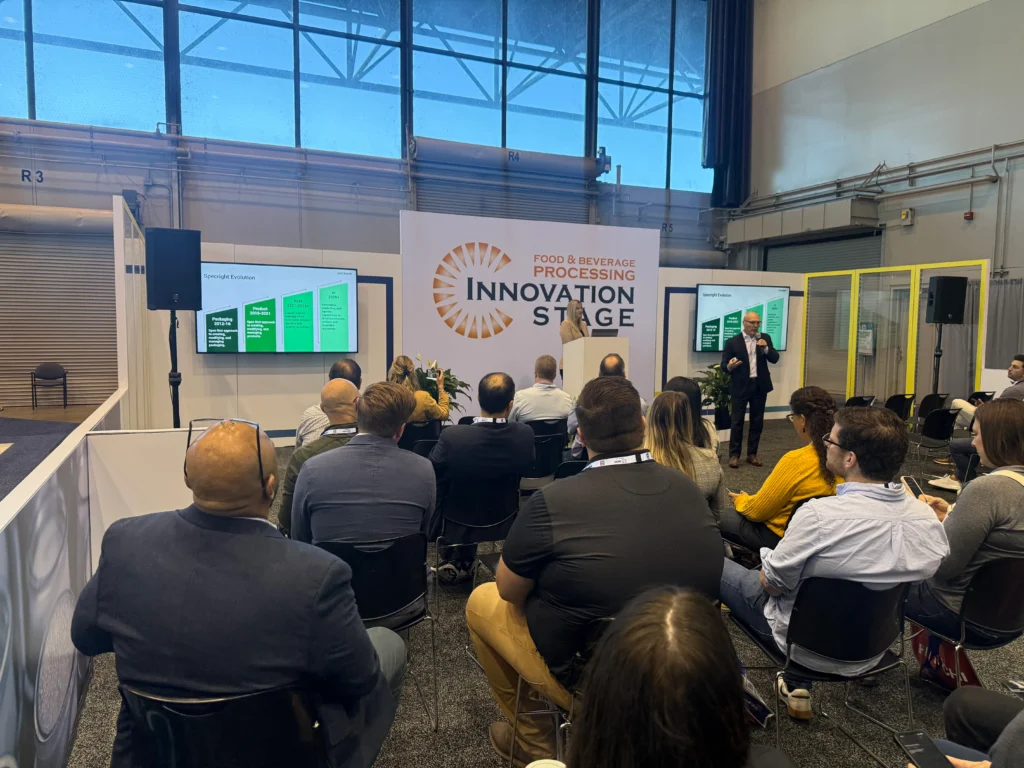
Mike Boese, Specright CEO, and Linda Garbis, former packaging professional and Specright Lead Solution Engineer
Mike and Linda followed one product from concept to retail-ready across three phases: Develop, Launch, and Scale. Linda paired a live platform walkthrough with stories from her own packaging engineering career. The result: unified spec data speeds iteration, keeps suppliers and internal teams on the same record, and turns compliance from reactive to proactive.
Five Key Takeaways from Pack Expo 2026
1. AI in packaging has moved from hype to action
AI in packaging is no longer a someday conversation. At Pack Expo 2026, attendees didn’t ask whether AI belongs in packaging development. They asked to see it work: answer a spec question in seconds, extract data from a supplier document, flag a compliance gap before launch.
The teams furthest along share one trait. Their AI runs on structured, connected specification data, not scattered files. AI built on incomplete data delivers incomplete answers. That’s why Specright’s approach is simple: power AI with the right data.
Karthik Rajagopal, Specright CPO, made the same case in a video interview with Packaging World. Quality, packaging, product, supplier, and procurement teams all need “a single source of truth, which is unfortunately not the case today.” He explained how Specright’s Spec Graph connects products, formulas, ingredients, packages, and materials, so AI answers are grounded in real data “without AI hallucinating.” Purpose-built Agents keep that data in sync and support decisions like packaging selection for compliance and recyclability. And on data security, he was clear: “the customer’s data set is never used for training AI.”
2. Most packaging spec data still lives in spreadsheets
For all the AI excitement, one reality stood out on the show floor: most companies still manage packaging specifications in spreadsheets. Some aren’t capturing much spec data at all.
That’s the gap holding AI back. AI can’t reason over data that doesn’t exist, and no one should trust it on data spread across ten versions in five shared drives. Specifications are the DNA of every product. You can’t manage products without managing what they’re made of.
| The traditional approach | The spec-first approach |
|---|---|
| Spreadsheets and PDFs scattered across systems | A single source of truth for all specification data |
| AI built on incomplete or siloed data | AI powered by structured, connected spec data |
| Manual processes and email collaboration | Automated workflows, real-time collaboration, and Agents in action |
| Reactive compliance | Proactive compliance |
The fix is a structured foundation for spec data, what Specright calls intelligent Specification Data Management™ (SDM). It’s more achievable than most teams expect, especially when suppliers help build it.
3. EPR compliance is splitting the industry in two
EPR compliance was a primary driver of booth conversations at Pack Expo 2026, and those conversations have shifted from just education to now also execution. Teams no longer asked what EPR is. They asked how to get it done. A clear divide has formed. Companies that started organizing their packaging spec data years ago are ahead. Others don’t know where to begin.
EPR is also only one piece of packaging compliance. Attendees asked how to manage rules beyond extended producer responsibility, from the EU’s Packaging and Packaging Waste Regulation (PPWR) to recycled-content mandates and customer-specific requirements. Matthew and Matt made the answer clear on stage during their presentation: compliance gets easier, and cheaper, when the rules live in the spec from the start instead of getting retrofitted at reporting time.
In the “don’t know where to begin” group? Start with the data you already have. Find the gaps. Bring suppliers in early. Our team can help with this.
4. Supplier collaboration is the fastest path to complete data
We heard the same challenge at the booth again and again: teams know they need complete, accurate packaging data from suppliers (and for AI initiatives), but they don’t have the people to chase it. Emailing hundreds of suppliers, following up, and re-keying their answers into internal systems isn’t realistic for a lean team.
That’s why the Specright’s Supplier Network drew so much interest: it solves the vendor data collection problem directly. Attendees saw it as a critical part of data onboarding. Suppliers share and maintain their own data in one place, so internal teams aren’t stuck doing all the outreach. As Karthik told Packaging World, traditional tools treat suppliers like “second-class citizens.” Specright makes suppliers “an equal citizen” in the process.
For teams facing EPR deadlines with limited headcount, strong supplier data management isn’t a nice-to-have. It’s how the data actually gets collected.
5. Packaging teams want one platform for every spec
Some of the most common booth questions were about what Specright’s SDM™ and Product Lifecycle Management (PLM) solutions can hold. Attendees asked:
- What data fields are available? Teams want to know whether their spreadsheet columns carry over, and what else they should be capturing.
- Can we track materials, dimensions, and sustainability data for every packaging component? Specright keeps all packaging specs in one record, including materials, dimensions, artwork and sustainability metrics. It then ties that to EPR reporting.
- Can we manage compliance rules beyond EPR? Once spec data is structured, the same record can support multiple regulatory and customer requirements.
Existing Specright customers made discoveries of their own. Interest in AI capabilities ran high, and many customers found new use cases for the platform across more departments than they use it for today, extending the same spec data beyond packaging to the teams that depend on it.
The message was consistent. Packaging teams don’t want another narrow point solution. They want one place for all the data that defines their products and packaging.
Intelligence starts with the spec
Pack Expo 2026 had one message: doing more with less starts with the spec. The teams putting AI into action today, and getting ahead of EPR instead of reacting to it, are the ones that built a strong data foundation and brought their suppliers into the process.
Thank you to everyone who joined our sessions, stopped by the booth, and shared what you’re working on. The conversation doesn’t end in Chicago.
Missed us at Pack Expo? Request a demo to see how Specright helps packaging teams put AI into action, or explore the Supplier Network to get supplier data flowing.

-

Laura Sams
Laura leads content marketing for Specright, overseeing brand and customer storytelling. Before joining Specright in 2021, she held marketing leadership positions at GE Digital, Meridium, and Carilion Clinic. She’s a storyteller at heart and is always looking for new ways to share innovation and inspiring stories. Laura is resides in Roanoke, Va., with her husband Matt, and two children Marie and Luke.
Explore More Blogs
-

Pack Expo 2026 Recap: 5 Takeaways on AI, EPR Compliance, and Supplier Data
Read More → : Pack Expo 2026 Recap: 5 Takeaways on AI, EPR Compliance, and Supplier Data -

Three Things Most Brands Get Wrong About Ecomodulation
Read More → : Three Things Most Brands Get Wrong About Ecomodulation -

Start With What You Know: What Sustainability in Packaging Europe Revealed About PPWR Compliance
Read More → : Start With What You Know: What Sustainability in Packaging Europe Revealed About PPWR Compliance


Get Started
With Specright’s Solution Suite, you can digitize, centralize, and link your specification data to drive efficiencies, intelligence, traceability, and collaboration within your organization and across your supply chain network.