

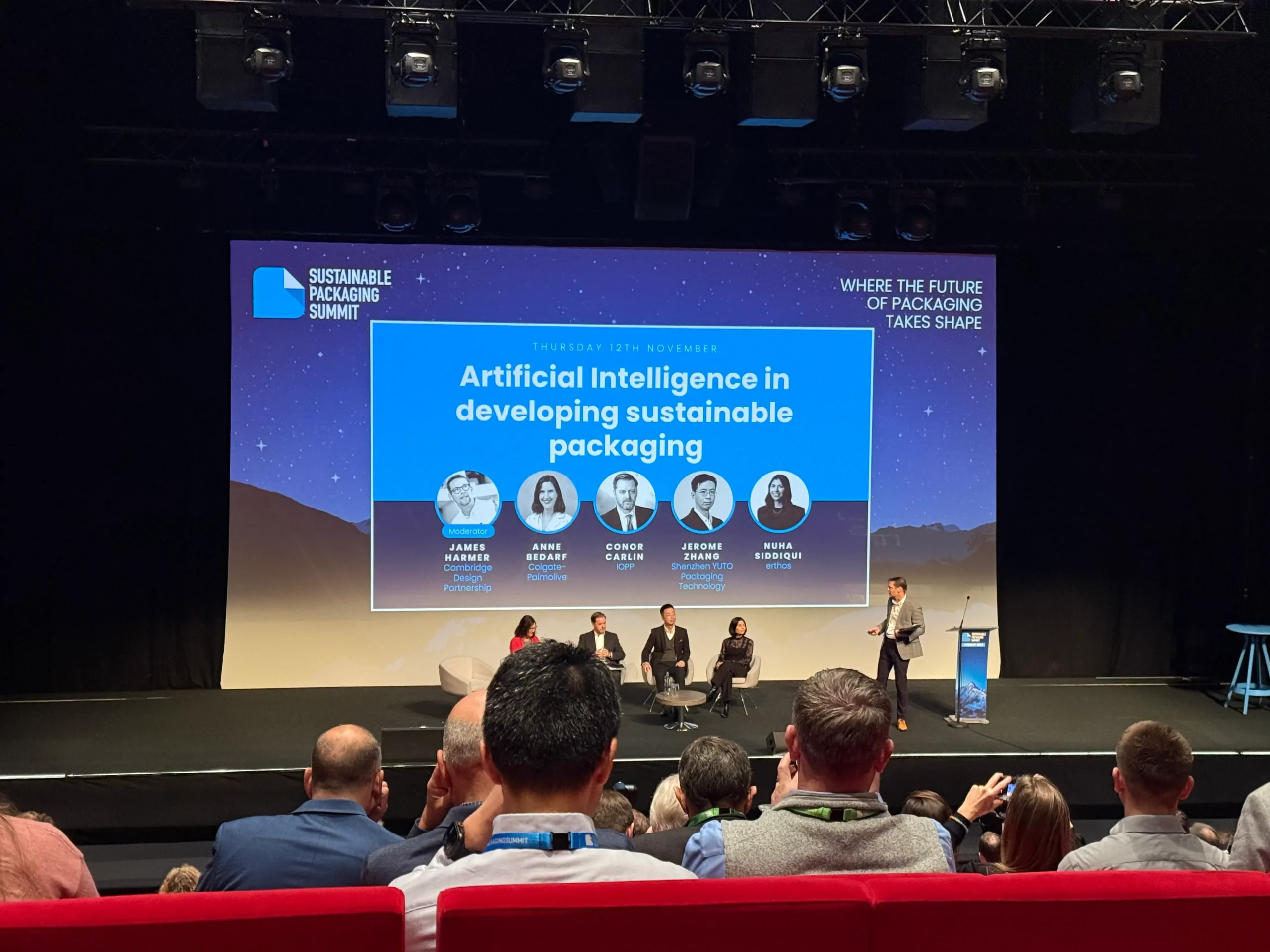
Earlier this month, I was in Utrecht for Packaging Europe’s Sustainable Packaging Summit 2026, held at the Jaarbeurs convention center. Around 1,000 people attended: brands, retailers, converters, material suppliers, producer responsibility organizations (PROs), start-ups and European Commission officials.
The first obligations of the EU’s Packaging and Packaging Waste Regulation (PPWR) applied on 12 August 2026. Since Sustainability in Packaging Europe in Barcelona in October, the conversation had moved on again. Fewer people asked whether PPWR would hold. More asked who inside their business should own it, and how to get suppliers on board.
Five themes came up again and again:
- The European Commission is clear that PPWR is here to stay.
- Supplier data is the critical path to compliance.
- Packaging teams have a unique opportunity to own PPWR and take it to the boardroom.
- AI got less airtime than I expected, but the conversations it did get were some of the most thought-provoking of the week.
- Collaboration ran through everything, from the main stage to the Sustainability Awards.
I also got to open the summit. My colleague Chris Warren, Strategic Account Executive, and I led the first session of the week, a workshop called Compliance & Sustainability Starts with the Spec. Our live polls drew the same reactions we heard on the main stage all week.
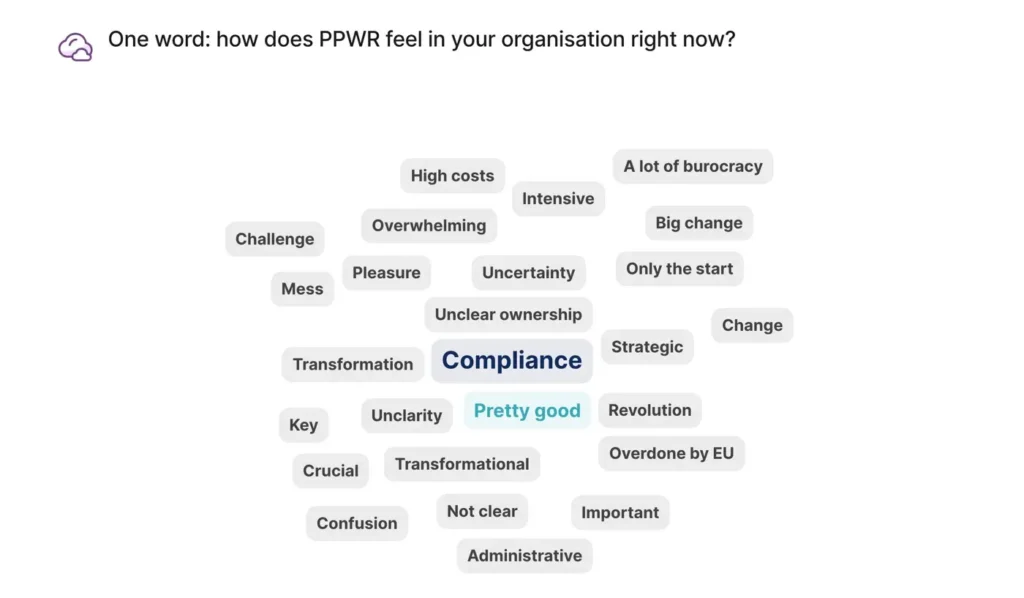
To kick off, we asked the audience for one word to describe how PPWR feels in their organization right now. The most common answer was “compliance.” Around it sat uncertainty, unclear ownership, overwhelming, high costs and a lot of bureaucracy. But we also saw strategic, transformation and only the start.
1. PPWR is here to stay, and the Commission wants industry leadership to match
The European Regulation at the Crossroads panel, chaired by EUROPEN, covered a lot of ground. One panelist called confidence the biggest gap right now, because businesses struggle to act while secondary legislation is still arriving. The panel also discussed the rising cost of acting compared with when the PPWR journey started, how ambitious the targets are, and the demand signal and investment case that recycled content targets still need.
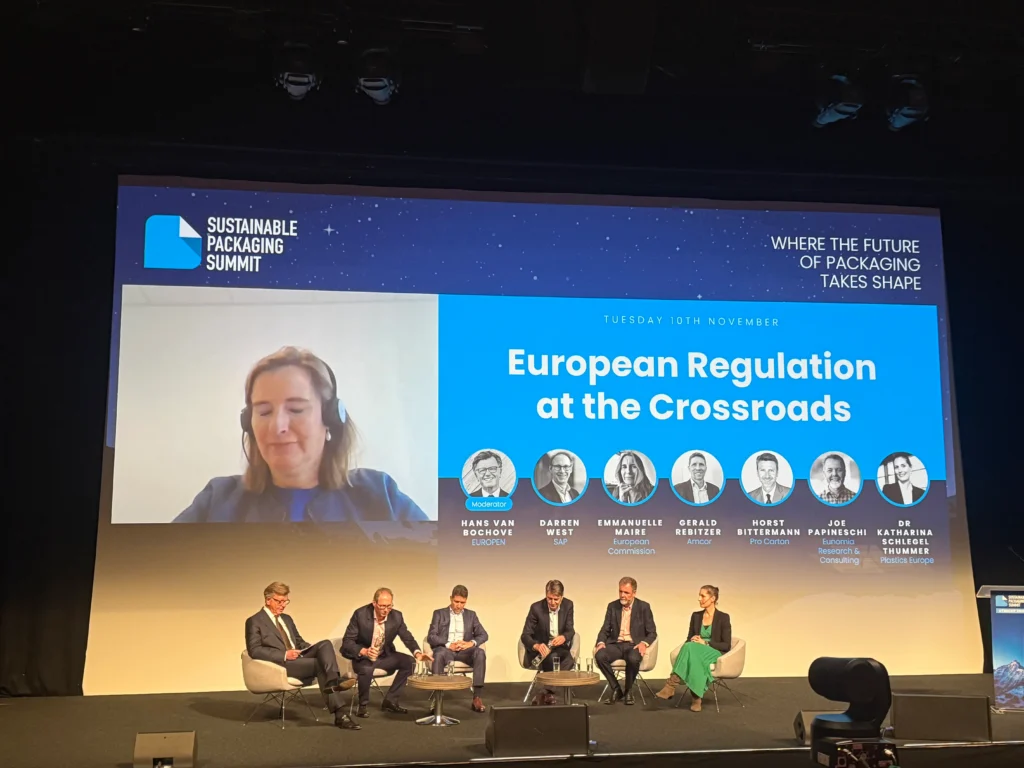
Emmanuelle Maire, Head of Unit at DG Environment, did not hedge. She said more than once that PPWR is here to stay and the Commission will not reopen it. Its job now is secondary legislation, starting with plastic packaging and design for recycling, and building the governance to make it work.
She described three groups that will work with the Commission:
- A committee of member state representatives, which will produce most of the secondary legislation
- An expert group of around 200 member state, producer responsibility and industry organizations, which will be kept informed and can feed in remarks
- A new group of national enforcement authorities, due to meet for the first time this November
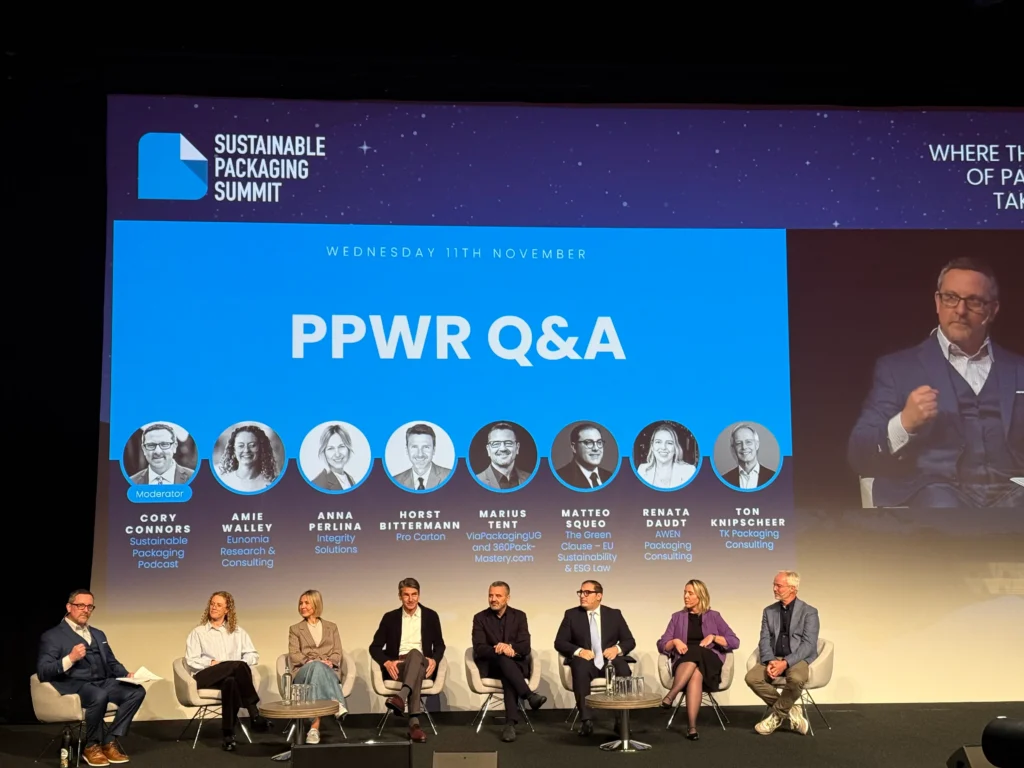
The PPWR Q&A panel on day two echoed her. Panelists said the Commission is doing more education and asking for more feedback than on any packaging law before it. It is publishing FAQs and giving uniform interpretations where it can, such as on wrapping and straps for transport packaging. One line summed it up: 12 August was the warm-up, and the next 10 to 15 years are the hard work.
My take: waiting for PPWR to soften is no longer a strategy. The Commission has opened the door, so use it. Feed into secondary legislation through your industry associations, act on what is already known, and treat PPWR as it was designed to be: one rulebook for one European market.
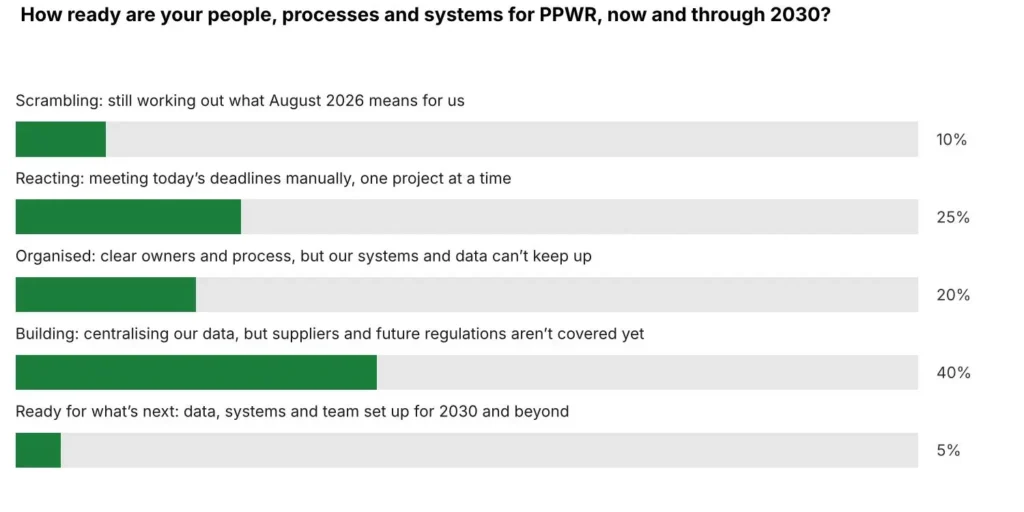
Our workshop poll showed how much work is still ahead:
- Only one person in the room said their data, systems and team are ready for 2030 and beyond.
- 40% are centralizing their data but have not yet covered suppliers or future regulations.
- 25% are still meeting today’s deadlines manually, one project at a time.
Tesco’s Paul Earnshaw put it best. We should use PPWR as an opportunity to help save the planet, and that is why we should embrace it together.
2. Supplier data is the critical path to PPWR compliance
Tesco’s keynote turned the data challenge into one slide. A single product can have many packaging parts. Each part carries its own data: material type, weight, dimensions, color, recycled content, food contact, barrier properties, inks, coatings, adhesives and supplier information. With roughly 40,000 products in store, Tesco estimates it needs around 12 million data points.
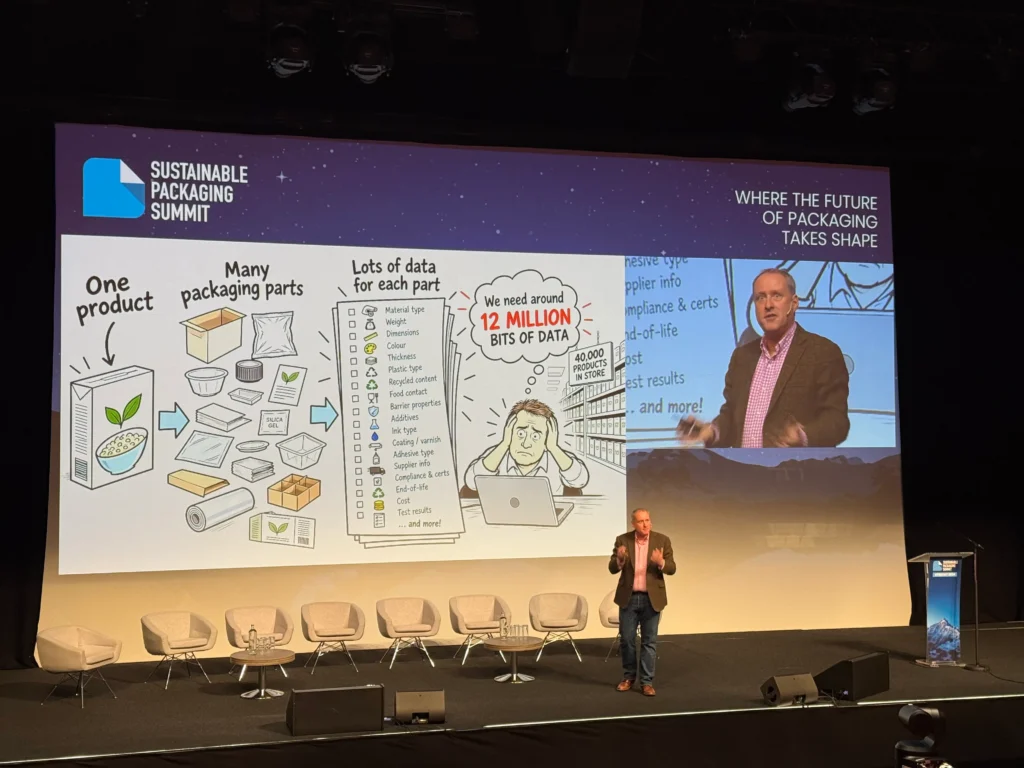
Most of that data is held by the suppliers who make the packaging. The PPWR Q&A panel was direct about what that means. A clause in a supplier contract is a start, but the brand is still the one reporting, so it has to check what suppliers send. Brands also need to understand what they are asking for and why.
Suppliers, particularly large converters in Asia serving customers worldwide, get requests from everyone. Vague or uneducated requests frustrate them and slow everything down. Clear direction on what data is needed, and how, gets better data back.
The panel also described a shift in timing. Collecting supplier data for 12 August was a one-off exercise. Now companies are building PPWR data into supplier qualification and selection, starting with a simple question: can this supplier give us the data at all? As one panelist put it, PPWR is a great test of whether you have the right suppliers, and agreeing on what data to share is the sign of a good partnership.
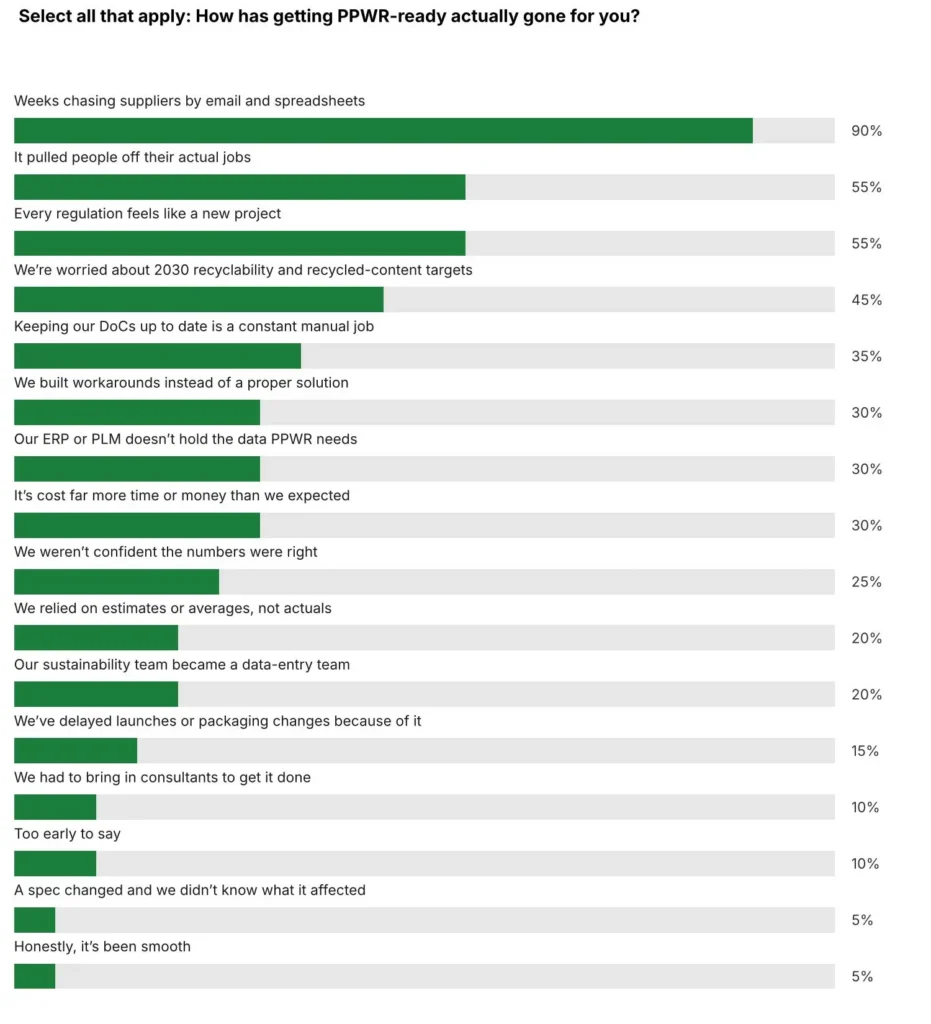
Our workshop poll showed how getting PPWR-ready has really gone:
- 90% spent weeks chasing suppliers by email and spreadsheets. No other answer came close.
- 25% were not confident their numbers were right.
- 20% relied on estimates or averages instead of actuals.
In our workshop, we showed a simpler way to work with suppliers. Suppliers send what they already have: a PDF, a certificate or a spreadsheet, in any language. The data is checked against the specification as it arrives, with no new template to fill in, and missing fields are flagged at upload. Suppliers answer once instead of once per customer.
Most reporting gaps are supplier data gaps. Closing them has to work for both sides.
3. Packaging teams should own PPWR and take it to the board
One phrase from the PPWR Q&A stayed with me: PPWR takes packaging out of the warehouse and into the boardroom. It is a board-level conversation. If you can’t make your packaging compliant, you will struggle to sell. That means dedicated people, finance at the table and an organization that understands the risk.
“Unclear ownership” showed up in our own word cloud, and our polls showed the cost of leaving PPWR unowned:
- 55% said PPWR pulled people off their actual jobs.
- 20% said their sustainability team had become a data-entry team.
The European Regulation at the Crossroads panel reached the same conclusion from a different angle. When the CFO asks how big PPWR is and how to fix it, the packaging lead finally has a business case to write:
- Market access protected
- EPR fees reduced through eco-modulation
- Operating cost taken out of the reporting process
This is the packaging engineer’s moment to take the topic upward and secure investment in the data foundation that makes better, more sustainable choices possible.
We closed our workshop on exactly that question. We followed a fictional packaging engineer through a week of PPWR work, but a better week does not get a budget approved on its own. Chris walked the room through how she got her project funded. Attendees entered their own specs, suppliers and markets into our ROI calculator, and Chris showed how that becomes an executive business summary written in finance’s language.
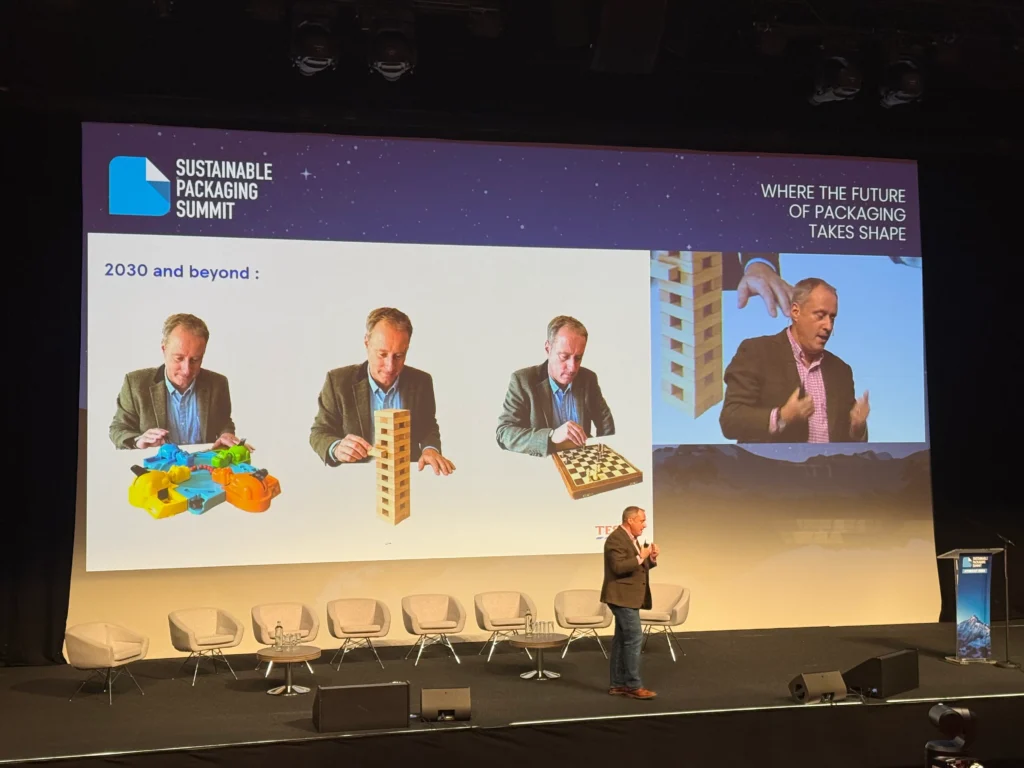
Tesco described how its packaging team has worked so far. The early years felt like Hungry Hippos, grabbing whatever came along. Now the work is more organized, like Jenga. Paul wants to be playing chess, with two new pieces on the board: PPWR as the must-do, and AI to help crunch the data.
His worry was skills. If AI does more of the checking, who will train the next junior packaging engineers, and who will be left who can check the AI? Investing in people is part of the plan.
pladis: from pack to platform
My favorite talk of the week was Russell Avens, Global Packaging Director at pladis. He described a packaging team whose remit now spans sustainability commitments, innovation with brand teams and operational excellence. Digitization is the biggest change, and the biggest opportunity to drive change across the business. His opening line: the next generation of packaging will not only protect products. It will connect consumers, information and experiences.
He named three forces converging on the pack:
- Retail transformation, with QR codes on pack set to scale from 2027
- Consumers adopting AI-assisted shopping fast
- Regulation, with PPWR recyclability targets
He then walked through the consumer journey, from discover to choose, enjoy, re-engage and dispose, and showed that packaging plays a part at every stage. A Godiva pack uses augmented reality to let shoppers see the chocolates and fillings inside, with one QR code deployable worldwide and scan data showing where the pack performs best, airports included. A Ramadan calendar adapted the advent calendar idea and moved much of the experience to a scan, so it needed less packaging.
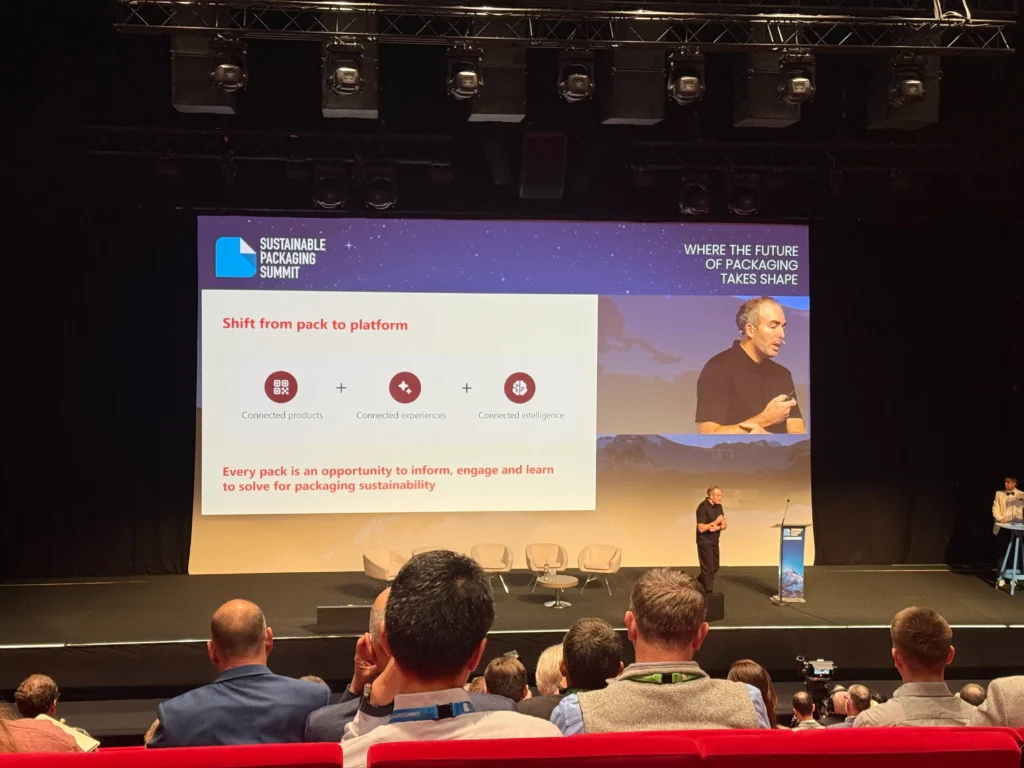
His close was the shift from pack to platform: connected products, connected experiences and connected intelligence. Packaging teams, he argued, can guide the organization through all three.
What I loved was the connected thinking. The same component-level data behind a Declaration of Conformity also feeds the QR code, the digital label and the insight that comes back from the scan. The packaging engineer who owns that data owns the conversation.
For packaging engineers, this is the time to step up. Build the business case in the language finance and the board use: market access, EPR cost, operating cost and growth. Bring the data with you, and position your team as the one that connects compliance, sustainability and the consumer experience.
4. AI: less of it than expected, and more provocative for it
The AI panel on the final morning opened with a blunt observation: AI had barely come up all week. The discussion that followed was worth the wait.
AI has moved from 2D marketing work, like new flavors and packaging concepts, into physical packaging development. Cambridge Design Partnership described combining data, physics and machine learning to model packaging performance. The result is fewer tests and faster decisions, and the goal is unlocking new formulations faster, not 100% accuracy. Colgate-Palmolive described working with erthos to speed up the development of sustainable, bio-based packaging materials.
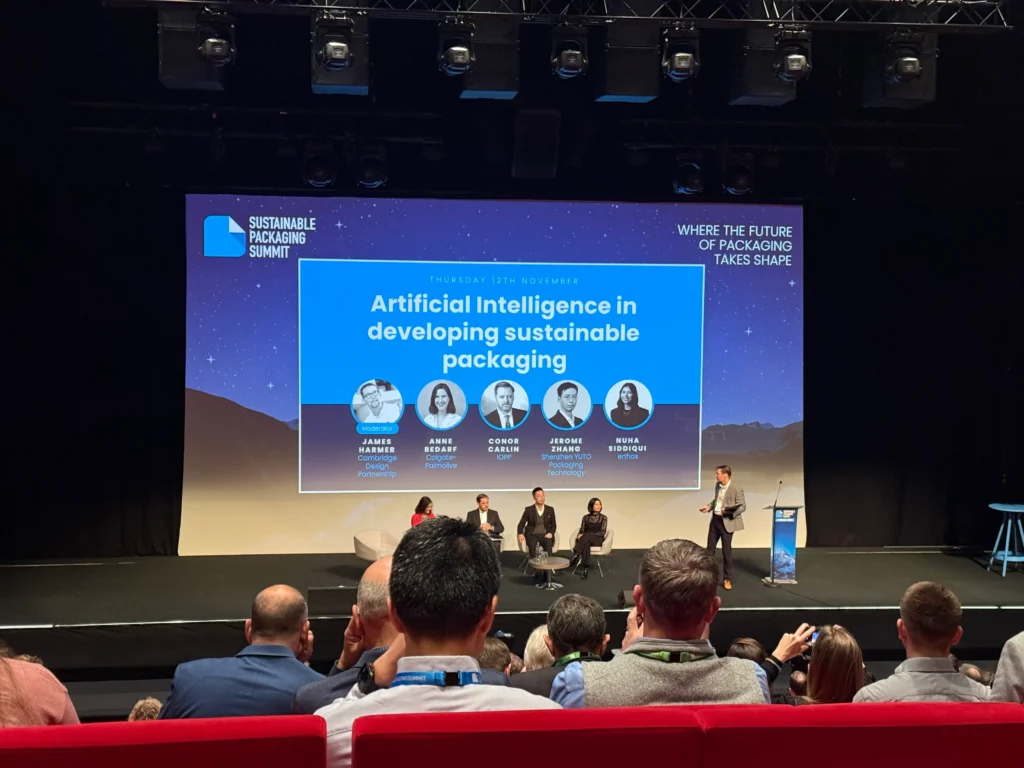
Two ideas stood out to me:
- AI is like a newer colleague, not someone who knows it all, so the humans stay. One panelist described onboarding each AI agent like a new employee, with a set of rules stored in its long-term memory and a self-audit after every output, with hallucination strictly ruled out.
- Not all data is high quality, or even needed. Nuha Siddiqui of erthos explained how they isolate the minimum data needed for each problem and generate small data sets to fill the gaps.
The panel’s warning was that the bigger risk is not taking advantage of what AI offers.
The PPWR Q&A had its own provocative moment. An audience member asked: “If I give false information, how would anyone know?” The panel took the question seriously. Early enforcement checks are largely binary: is there a Declaration of Conformity, and is the packaging identified? You don’t need a lab to spot a missing document. The bigger point was that the question misses the intent. PPWR asks for real evidence, not hope that an inspector checks five packs out of fifty.
We put AI at the center of our own workshop, because our polls showed where the time goes:
- 55% said every regulation feels like a new project.
- 35% said keeping Declarations of Conformity up to date is a constant manual job.
- 30% said their ERP or PLM does not hold the data PPWR needs.
AI only helps with that when it works from structured, connected specification data. So we followed our fictional packaging engineer through her week with the Specright AI Assistant:
- Monday: It answered a recyclability question that once took a portfolio audit. It flagged metallized PET/PE wrappers as RecyClass grade E and a mono-material PP alternative as grade B, with sources cited and the EPR fee impact alongside.
- Tuesday: It found data gaps and mis-keyed values before she contacted a single supplier.
- Wednesday: It read supplier documents in their own language and format.
- Thursday: A supplier’s adhesive change flowed through to every affected spec, and her Declarations of Conformity regenerated in one go.
When her CFO asked for EPR fees by market, the answer came from the same data through Lorax. Any new report takes a natural-language request and a few minutes.

Plenty of people in the room were still skeptical of AI, or still working out how to use it. Our advice was to ask the questions that tell you which AI you can trust. In Specright, the AI does the reading, but it does not guess. Every check follows the same rules, so you get the same answer every time, and you can see how it got there.
The AI does the work, and the packaging engineer makes the decision. That matches the panel’s newer-colleague view, and it answers Tesco’s worry about skills.
None of that week was really sustainability work. It was finding data and moving it around. Take that away and she gets her real job back: designing better packaging, spending more time on innovation, and leaving on time on Friday.
5. Collaboration ran through every part of the week
I said last year that SPS was the most collaborative event I attended, and 2026 confirmed it. Our workshop room held brand owners, packaging producers, material suppliers, and the people who run EPR schemes and recyclability assessments, all working on the same problem.
The speakers kept coming back to it too. The Commission called for mutually reinforcing leadership. The PPWR Q&A advised agreeing with suppliers on what data to share, and optimizing once across the UK, EU and other markets by meeting the strictest rule and using it everywhere. Tesco closed by asking the industry to help educate the market.
Supplier data is where collaboration matters most. Brands should treat every data request as a chance to educate and inform their suppliers:
- Explain what PPWR requires, why each data point matters and how the data will be used.
- Agree on fields and formats up front.
- Accept the documents suppliers already hold.
- Share feedback when something is missing, so the next request is easier.
Suppliers who understand the why respond faster and with better data. A request designed with suppliers in mind turns a compliance chore into a partnership that serves both sides.
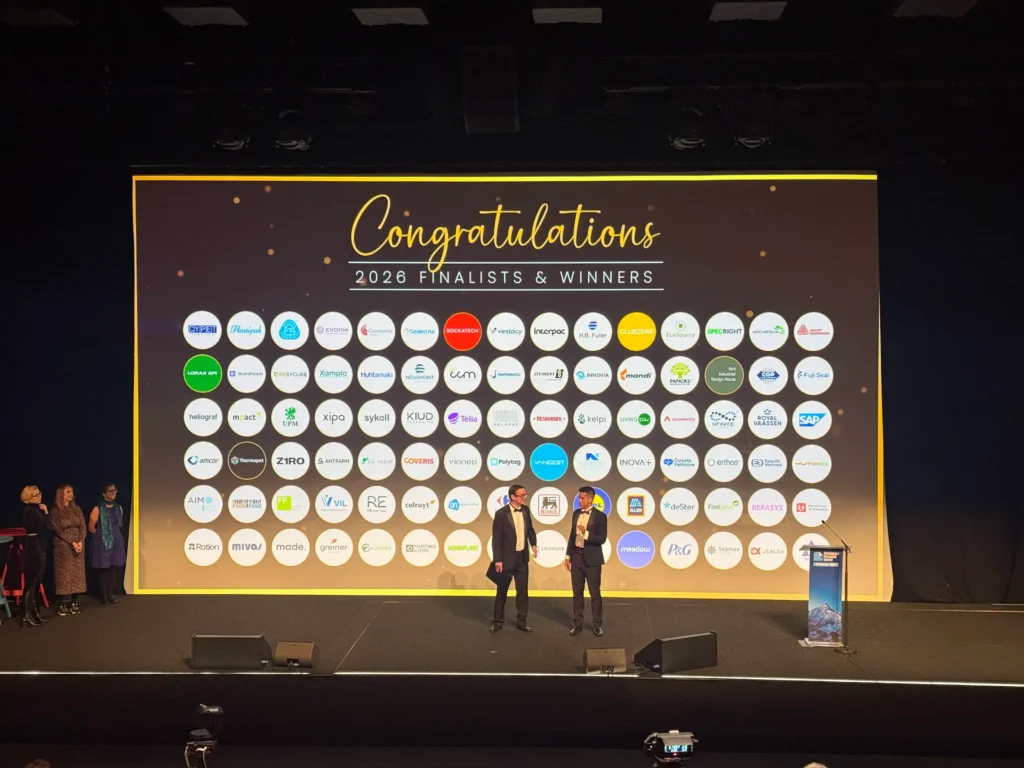
The 10th Sustainability Awards made the same point on stage. The overall winners were Interpac and H.B. Fuller, whose cold corrugator and ambient-temperature adhesive work together on a corrugated board process that H.B. Fuller says uses 98% less water and 41% less energy than conventional production.
Several other category winners were partnerships too: Xampla and Huhtamaki, Nfinite Nanotechnology and Amcor, Coveris and COtooClean, and the REPASYS reuse pilot. REPASYS brought together Pack4Food, Flanders’ FOOD and retailers including Albert Heijn, Colruyt, Carrefour, Delhaize, Lidl and Aldi.
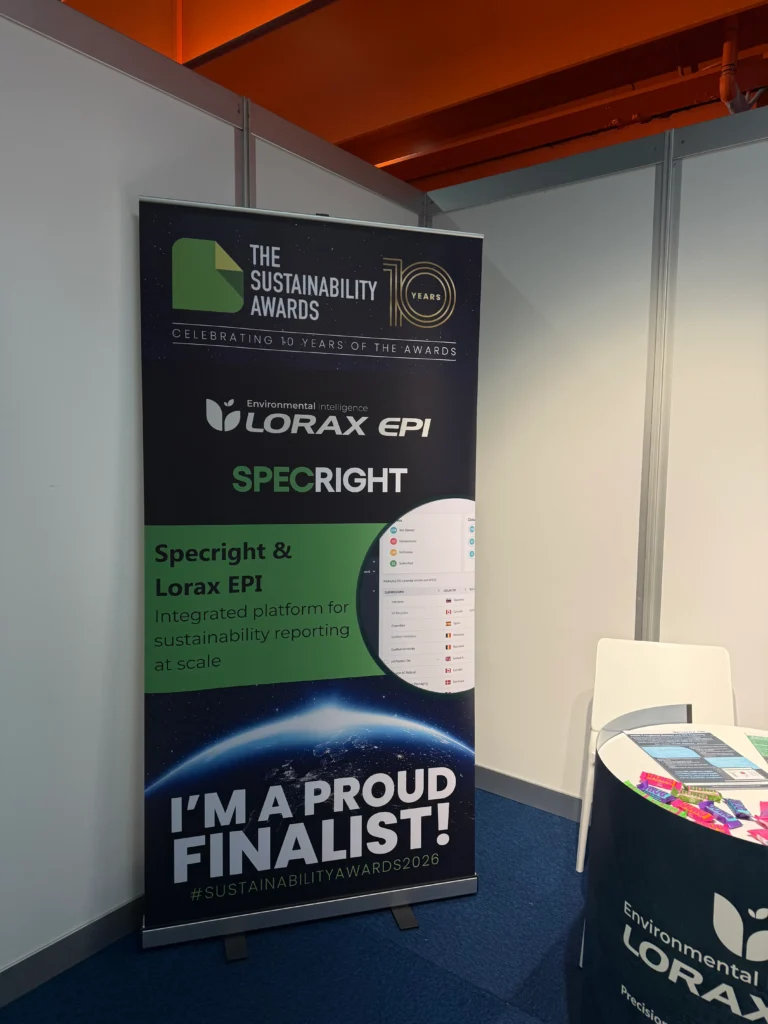
We were proud to be a finalist in the Digital Transformation category alongside our partner Lorax EPI. The entry was our integrated platform for sustainability reporting at scale, which connects Specright specification data with Lorax EPR calculations. Packaging Europe published our finalist interview, and we joined the finalists’ Q&A with Lorax on the final day.
Congratulations to CLUBZERØ, which took the category for its AI-powered, QR-based reuse system, and to every winner and finalist.
What does the Sustainable Packaging Summit 2026 mean for packaging teams?
The European Commission is moving forward with PPWR. It has said PPWR is here to stay, it is building the governance to make it work, and secondary legislation will keep arriving between now and 2030. The question for every business now is who leads.
That leader should be the packaging team. Packaging engineers know what every pack is made of, which suppliers hold the data, and what a design change really costs. PPWR gives them the reason to take that knowledge out of the warehouse and into the boardroom, with a business case built on market access, EPR cost and growth.
The teams that own the data, bring their suppliers with them and make the case to the board will set the pace for their companies. This is the moment for packaging to lead.
If your team is building a PPWR business case, working out how to collect supplier data at scale, or looking at what eco-modulated EPR fees mean for your portfolio, get in touch with our team. We can walk through what that looks like for you.
Explore More Blogs
-

Out of the Warehouse and Into the Boardroom: What the Sustainable Packaging Summit 2026 Revealed About PPWR
Read More → : Out of the Warehouse and Into the Boardroom: What the Sustainable Packaging Summit 2026 Revealed About PPWR -

EPR Is Here: Designing Packaging for Compliance
Read More → : EPR Is Here: Designing Packaging for Compliance -

What’s New in Specright: Fall 2026 Release
Read More → : What’s New in Specright: Fall 2026 Release

Get Started
With Specright’s Solution Suite, you can digitize, centralize, and link your specification data to drive efficiencies, intelligence, traceability, and collaboration within your organization and across your supply chain network.