Driving Sustainable Packaging Initiatives with Specright
Your Single Source of Truth for Sustainability Data
Sustainability is no longer just a brand differentiator. It’s a regulatory mandate with deadlines, fines, and reporting requirements. Globally, sustainability regulations are rising. Extended Producer Responsibility legislation (EPR) now covers seven U.S. states. The EU’s Packaging and Packaging Waste Regulation (PPWR) begins enforcement in August 2026. And the cost of getting packaging data wrong climbs every year.
How is your company rethinking its sustainable packaging strategies? The right sustainable packaging software can help you act faster, report accurately, and design with sustainability from day one.
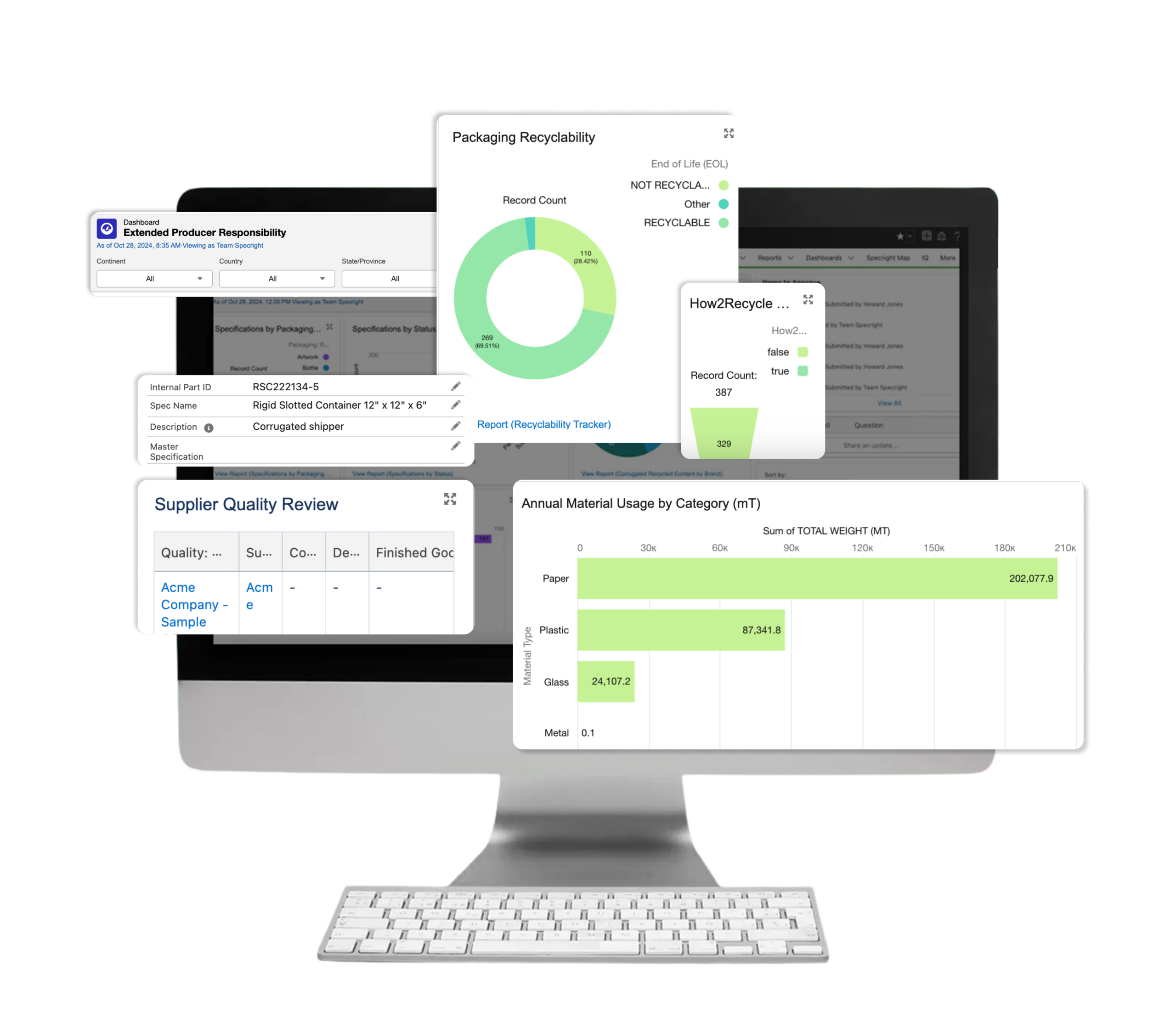
Specright is the sustainable packaging software that centralizes specification data into a single source of truth. Brands, retailers, and CPGs use that foundation to power every sustainability report, EPR submission, lifecycle assessment, and compliance audit. The results:
28%
Average savings on annual sustainability fees
44%
Time savings on sustainability and
regulatory reports
First EPR report in 4 to 6 months, versus 18 to 24 months manually
Most companies treat packaging engineering, sustainability, and compliance as three separate workstreams powered by three separate datasets. They’re not. Every sustainability metric — carbon footprint, recyclability, recycled content, EPR fee exposure — is calculated from the same underlying spec fields.
Specright’s purpose-built Specification Data Management (SDM) platform centralizes packaging data at the component level. Once that foundation exists, every downstream tool, partner, and report works from the same numbers — with an auditable trail every time a spec changes.
Centralize
Suppliers and internal teams contribute spec data — material type, weight, recycled content %, separability — directly into Specright.
Validate
Data completeness indicators and automated supplier outreach surface gaps before they become reporting failures.
Report
Export clean, structured data to any EPR tool, LCA platform, CSRD reporting engine, or carbon calculator — or generate reports directly with Lorax.
Unilever Prestige Implements Specright Across Enterprise
Unilever Prestige partnered with Specright on a centralized Specification Data Management (SDM) platform system to streamline its fragmented packaging and raw material specifications across 10 luxury beauty brands. The phased implementation across its brands focused on data standardization, regulatory compliance, and sustainability tracking, resulting in significant efficiency improvements and cost savings.
"We've been making great strides against our sustainability goals because Specright has helped us make room for innovation. We're no longer dependent on highly inefficient manual processes to manage more than 860 SKUs."
Kevin Davis
Director of Packaging Engineering, Dermalogica
The Features That Turn Data Into Sustainability Outcomes
EPR Report Generator
Powered By Lorax
Generate accurate Extended Producer Responsibility reports across U.S. states and global jurisdictions without the multi-week scramble each cycle. Customers shrink reporting time from 3 to 5 weeks per jurisdiction down to minutes, and reports auto-refresh as specifications change.
Catch sustainable packaging compliance issues before production. One click checks your designs against global regulations and material restrictions. Instantly flag active bans, prioritize EPR fee risks, and build a defensible audit trail.
Give consumers accurate, on-pack disposal instructions without re-keying data into a second system. The pre-built, one-way integration (Specright to How2Recycle) eliminates duplicate entry and reduces label rework.
Quantify environmental impact during design, when material changes still cost cents instead of millions. Packaging engineers and sustainability leads use clean BOM exports from Specright to run portfolio-scale Life Cycle Assessments in COMPASS.
Specright founded and powers the Sustainable Packaging Data Council (SPDC). The SPDC unites leading brands, retailers, technology partners, nonprofits, and academia around one shared mission: harmonize packaging data and accelerate sustainability.
As Extended Producer Responsibility (EPR) legislation rapidly expands across the United States, alongside other sustainability regulations such as the EU’s PPWR, the SPDC is helping organizations prepare by developing a standardized U.S. EPR data requirements framework, with PPWR templates forthcoming.
As sustainability regulations increase around the world and green manufacturing standards evolve, companies can find it challenging to stay up to date with frequent changes. Check out these resources to learn more about regulations that may be impacting your business.
The Ellen MacArthur Foundation
With an initial mission to raise awareness of the benefits of a circular economy and to drive systemic change toward this new economic model, The Ellen MacArthur Foundation has since become a leading voice on the topic of the circular economy.
In 2018, the UK government announced the new UK Plastic Packaging Tax in their budget as a part of the government’s 25-year environmental plan, and 4 years later it finally came into play. As of April 1st, 2022, any company importing or manufacturing 10+ tonnes of plastic packaging components in the UK will be subject to this tax. And this time there’s no exceptions for large companies trying to avoid sustainability practices.
The term “net zero” first came about from the concept of “carbon neutrality,” which refers to balancing carbon emissions with carbon removal. For years this term was highly regarded but the issue was it didn’t account for greenhouse gases, such as methane, besides carbon dioxide.
Just reducing carbon emissions was simply not enough, and architects, engineers, and supply chain professionals around the world saw this flaw.
California Climate Corporate Data Accountability Act (SB-253)
The Climate Corporate Data Accountability Act (SB 253) applies to reporting entities – partnerships, corporations, business entities, etc. – formed in California or operating under the laws of California with total annual revenues from the prior fiscal year that exceeds $1B. Companies that check these boxes will be required to report on their Scope 1, Scope 2 and Scope 3 GHG emissions to the state of California every year.
Signed into law by Governor Gavin Newsom on June 30, 2022, SB-54 sets ambitious targets for reducing single-use plastic packaging and foodware.
By 2032, California aims to cut single-use plastic packaging and foodware by 25%, ensure that 100% of these items are recyclable or compostable, recycle at least 65% of single-use plastic packaging and foodware.
These goals represent a significant shift in how we manage plastic waste, emphasizing reduction at the source rather than relying solely on end-of-life recycling efforts.
At its core, APCO (formerly known as the National Packaging Covenant) was established with the goal of uniting businesses, government, and industry stakeholders around sustainability initiatives. Initially, the organization took a voluntary commitment approach but has since become much more structured, introducing regulations and mandatory reporting to ensure compliance with sustainability goals.
The main goal of The Spain Packaging Tax is to create a better waste management solution that limits contaminated soils and certain plastic products all while promoting a circular economy.
With effects throughout the entire Spanish territory, manufacturers, importers, and transporters of any single-use plastic containers and/or packaging are going to have to reevaluate their material usage to meet the law.
With consumer demands for sustainability at an all-time high and regulations increasing globally, it is critical that companies embrace sustainable packaging to drive change. By running lifecycle analyses on the impact of your packaging, companies can better understand where change needs to take place and start developing eco friendly packaging and green packaging solutions that meet overarching sustainability goals.
Specright enables you to drive intelligence, traceability, and collaboration within your organization and across your supply chain by transforming siloed, disjointed specification information into a single source of truth, with invaluable real-time data streams that accelerate nearly every supply chain effort.
With 5 million+ products on Specright’s Specification Data Management (SDM) platform, we’re helping some of the world’s largest companies and challenger brands optimize costs, accelerate innovation, and reduce waste. See how you can join the Specification Management movement — we’ll start with a brief call to understand your goals and then schedule a tailored demo experience that fits your needs.