Food & beverage PLM that starts with the spec, so every formula, ingredient, and package is built on structured, connected data rather than a file in someone’s inbox.
Specright gives Food & Beverage teams one specification‑first PLM platform to manage recipes, packaging, suppliers, and artwork, with AI that understands your data.
Products managed on the Specification Data Management™ (SDM) platform.
25%
Increased revenue through accelerated time-to-market.
90%
Reduced data duplication.
Legacy PLMs Weren’t Built for Food
Legacy PLM wasn’t built for what food is made of. It was built for part numbers and assemblies, rather than formulas, ingredients, and packaging.
Most Food & Beverage teams still juggle specs across spreadsheets, shared drives, and supplier emails, with no version control or reliable single source of truth.
That’s why most systems treat specs as documents to store, while Specright treats every spec as structured, connected data. ‘Food & beverage PLM’ means software that manages the full product lifecycle. It covers everything from ingredient and formula through packaging and label to finished product. All of this runs on a foundation of specification‑first SDM™ with modern PLM built on that data foundation.
How Specright Works
Step 1: Ideation & Concept
Spec-first PLM starts every new product with clean, structured spec data. Scope ideas with simple project workflows and start building formulas in the R&D Workbench from day one, so products begin life with real specs instead of scattered notes.
Step 2: Design & Development
As you develop the product, formulas live and update in one place, with nutrition, allergen, and claims data calculated alongside them. Specright surfaces existing specs to reuse, then turns approved formulas into compliant labels and nutrition panels with less back-and-forth.
Step 3: Manufacturing
When a product is ready to make, its formulas flow into step-by-step manufacturing instructions for the plant floor. Supplier data stays current, and BOM variants or alternates keep production running when ingredients or packaging change.
Step 4: Service & Support
When one spec changes, Specright’s patented SpecGraph shows every product it affects and updates them together. AI tools surface answers and pull data on demand, while ERP and regulatory connections help teams stay ahead of FDA and FSMA requirements.
Step 5: End‑of‑Life
Even after a product is retired, its specs stay in the system with full history and version tracking. Records remain auditable and easy to find whenever you need them.
Track a product from ideation through formulation, finished good, and commercialization in one system. You gain a spec-first PLM with stage-gate workflows, tasks, and Gantt charts, with no chasing cross-functional status across tools.
Have suppliers enter spec data and certifications directly, so your data foundation is accurate from the first mile of the supply chain. All four sit on the same SDM™ foundation and SpecGraph, and connect with Packaging, Project Management, and Sustainability and EPR in the wider Specright platform.
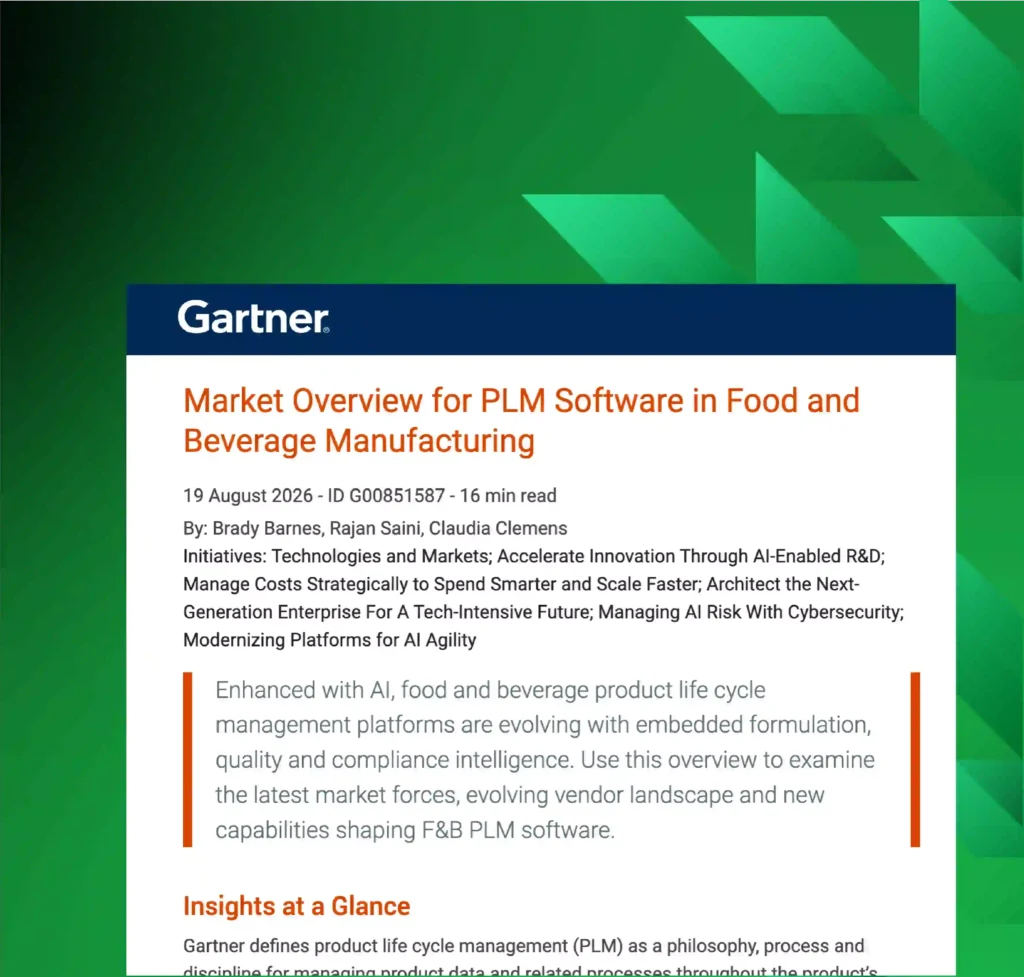
Gartner®: Market Overview for PLM Software in Food and Beverage Manufacturing
The 2026 Gartner® Market Overview for PLM Software in Food and Beverage Manufacturing outlines how the market is shifting from fragmented point solutions toward connected, AI-enabled product platforms. It highlights why purpose-built PLM has become essential to managing cost pressure, supply chain volatility, and mounting regulatory complexity.
Specright is built on patented Specification Data Management and the SpecGraph data model. Every spec is active, searchable, and connected instead of buried in static documents.
Built for What Food Is Made Of
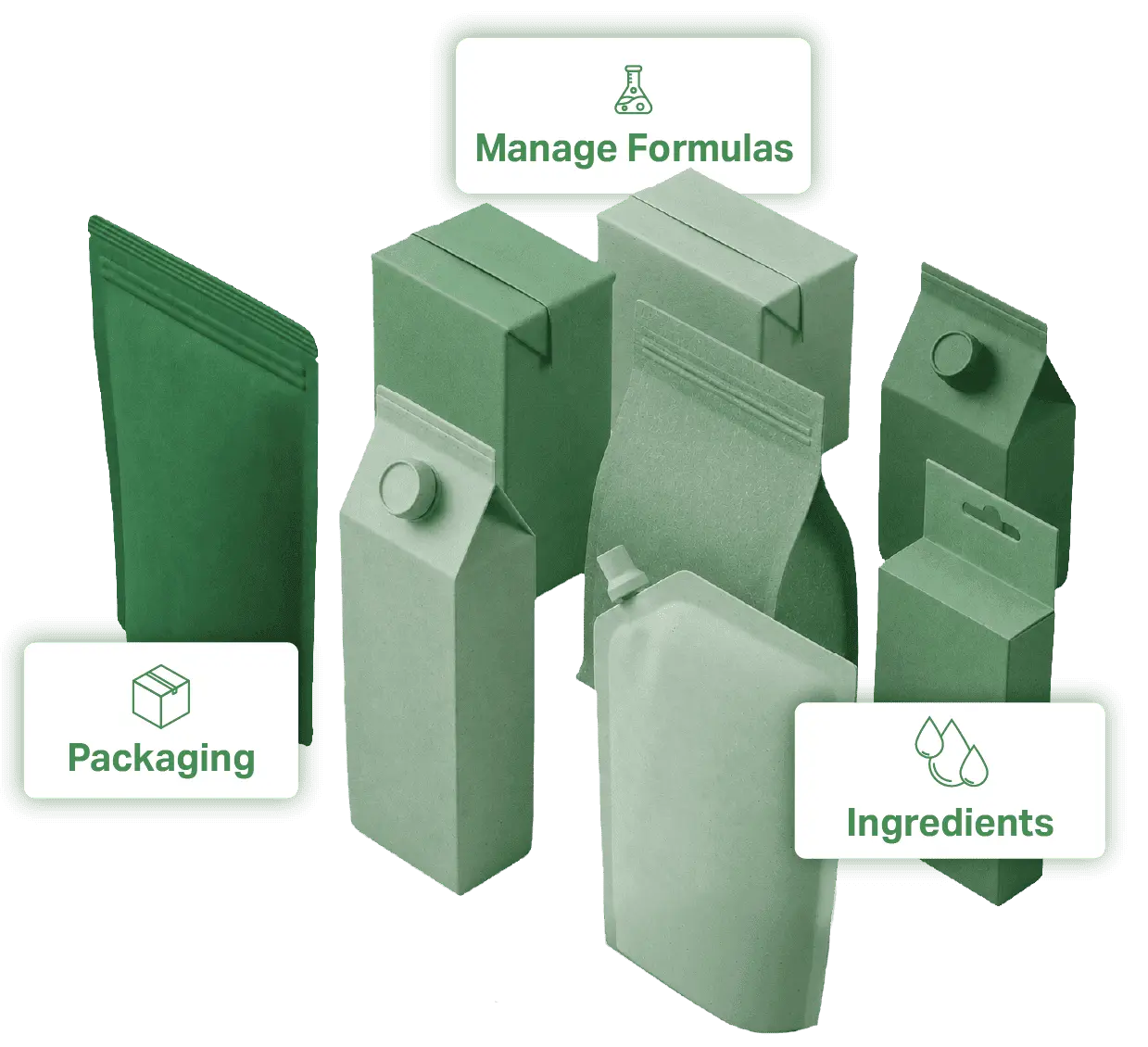
The platform models formulas, ingredients, and packaging in detail, with deep packaging engineering data and automated EPR and plastic‑tax reporting baked in.
AI Grounded in Real Spec Data
The F&B R&D Workbench uses validated, auditable specification data, so AI‑generated ideas, reformulations, and claims checks line up with your actual products and constraints.
Connected Teams & Suppliers
Brand, R&D, regulatory, packaging, and suppliers all in one system.
Works With Your ERP
ERPs run your business, while Specright runs the product and packaging data that feeds it.
Specright syncs structured specs, item/material masters, and multi‑level BOMs into ERPs like SAP and Oracle. It then brings back cost, supplier, and inventory data so decisions stay grounded in reality.
An open, API‑first architecture with pre‑built connectors to tools like TOPS, Lorax, Trayak COMPASS, 1WorldSync, How2Recycle, and PageProof keeps your stack intact rather than ripping and replacing your ERP.
Food & Beverage teams use Specright to replace scattered specs with one connected source of truth.
“Specright saves our team a tremendous amount of time while increasing visibility and transparency across our supplier relationships so we can focus on preventing issues.”
It is software that manages the Food & Beverage product lifecycle, from ingredient and formula to finished product, on structured specification data.
How is food-specific PLM different from general PLM?
Food-specific PLM is designed for process manufacturing. General PLM is designed mainly for discrete manufacturing.
Most general PLM platforms were built for industries like automotive and electronics, where products are assembled from fixed, countable parts that do not chemically change. In food and beverage, ingredients are mixed, cooked, or blended into something new. They’re also managed in batches using weights, volumes, and percentages instead of units. That means a formula is not a static parts list, but a flexible set of ratios that must scale, allow substitutions, and roll up allergen and claims data through every level.
Food-specific PLM must therefore natively handle formulas and recipes, allergen and claims rollups, supplier ingredient data, and compliant label generation for each market.
Specright is built as a spec-first PLM for process manufacturing in Food & Beverage, CPG, and Beauty, rather than retrofitted from a discrete-manufacturing model.
How does Specright support FSMA compliance?
Specright is the specification data foundation that makes FSMA compliance achievable – not a standalone compliance system.
It ties documentation, supplier verification, allergen data, and corrective actions directly to the spec, so records are timestamped, version-tracked, and retrievable fast when the FDA comes calling, rather than scattered across emails and spreadsheets.
Specright works alongside your QMS and HACCP systems, giving them structured, traceable spec data to run on.
Does Specright support 21 CFR Part 11?
Specright supports the access controls, audit trails, and e-signature integrations required for 21 CFR Part 11. You control how the platform is configured to meet your specific compliance needs, and we can connect you with trusted consultants to help validate your implementation.
How does Specright speed up new product development?
Teams reuse and clone existing specs, formulas, and packaging data instead of starting from scratch – cutting duplicate SKUs by 19% – and replace manual handoffs with connected workflows. Customers report cutting spec approval time nearly in half, from 21 days to 11, directly accelerating product launches.
Does Specright replace our ERP?
Specright does not replace your ERP. ERPs run the business; Specright runs the product and packaging data that powers it. Specright feeds spec data, item and material masters, and multi-level BOMs into the ERP, and pulls cost, supplier, and inventory data back through an open, API-first architecture with pre-built connectors.
What does Specright cost?
Specright offers modular plans and directs buyers to request a quote.
Get the Spec Right
Specright turns scattered Food & Beverage specs into one connected source of truth for formulas, ingredients, packaging, and product data, so teams work from the same version every time.
With 5 million+ products on Specright’s Specification Data Management (SDM) platform, we’re helping some of the world’s largest companies and challenger brands optimize costs, accelerate innovation, and reduce waste. See how you can join the Specification Management movement — we’ll start with a brief call to understand your goals and then schedule a tailored demo experience that fits your needs.