


The EU’s Packaging and Packaging Waste Regulation (PPWR) isn’t just another compliance deadline. It’s the start of a decade-long transformation — and most companies are already behind.
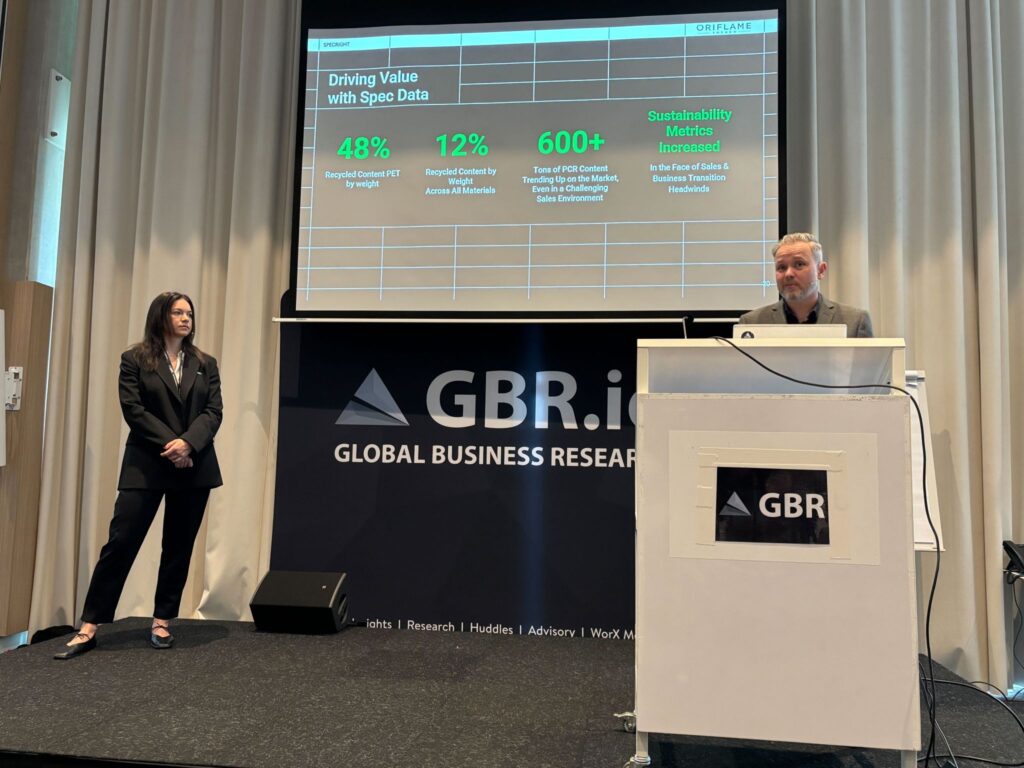
A few weeks ago, I had the opportunity to speak at PackagingWorX in Amsterdam alongside Richard Beckett, Senior Packaging Project Manager Sustainability at Oriflame. Over two days and dozens of conversations with packaging leaders from across Europe, one theme emerged clearly and consistently:
Packaging is no longer a design challenge – it’s a data challenge.
With the EU’s Packaging and Packaging Waste Regulation (PPWR) deadline of August 12, 2026 now just five months away, organizations are entering a critical — and rapidly closing — window of preparation. Five months may sound like enough time. For many companies, it isn’t. And the harder truth? PPWR is not a one-time compliance event. It is the opening chapter of a decade-long transformation in how packaging is designed, tracked, reported, and managed.
PPWR Is Bigger Than You Think

At PackagingWorX, speaker after speaker described the same pattern playing out across their organizations: delayed product launches because packaging changes weren’t anticipated early enough, emergency redesigns to chase evolving requirements, sustainability progress quietly eroding because no one was tracking it, and operational disruption caused by fragmented data spread across systems, regions, and teams.
This isn’t theoretical risk management. It’s already happening — at major companies with large, experienced packaging teams.
The reason, more often than not, isn’t a lack of intent or commitment. It’s a lack of visibility and control over packaging data.
PPWR introduces a set of interconnected requirements that compound in complexity:
- Declaration of Compliance (DoC) — documented evidence that packaging meets PPWR recyclability, material, and design standards
- Recyclability and material transparency — traceable, reportable data on composition at SKU level
- Digital Product Passports (DPP) — machine-readable records that travel with the product through the supply chain
- Ongoing multi-market reporting — continuous compliance, not a point-in-time snapshot
These are not siloed requirements. They’re interconnected — and they all depend on the same foundation: reliable, structured, centralized packaging data.
Why Most Companies Aren’t Ready
One of the most resonant observations from PackagingWorX came not from a regulatory briefing, but from a candid conversation about execution:
“Packaging design rarely fails technically — it fails due to lack of communication and collaboration.” — Heard at PackagingWorX, Amsterdam
That quote cuts to the heart of the readiness problem. Most organizations today are operating with packaging data that is fragmented by design — spread across regional systems, locked in spreadsheets, buried in email threads, or siloed within individual functions. There is no single source of truth. There is no consistent vocabulary across R&D, procurement, sustainability, and regulatory. And there is no reliable way to track progress over time.
PPWR requires the exact opposite of this model. It requires end-to-end alignment across the entire packaging lifecycle — from material sourcing through design, production, reporting, and eventual disposal or recycling. That cannot happen without a shared data infrastructure.
What to Do Right Now: Five Priorities for the Next Five Months
If you’re responsible for packaging, sustainability, or compliance at your organization, this is your action window. Here is where to focus.
1. Build Your Declaration of Compliance (DoC) Foundation
The DoC is not a document you produce at the end of the process. It is the output of having structured, validated, traceable packaging data in place throughout your operations. If you’re hoping to compile it manually in the weeks before the deadline, you are setting yourself up for a painful, error-prone scramble — and a document you won’t fully trust.
True DoC readiness means you have full visibility into materials, components, and suppliers; confidence in recyclability and composition data at the SKU level; and the ability to pull and report that data on demand. That requires infrastructure, not a spreadsheet sprint.
2. Rationalize and Simplify Your Packaging Portfolio
At PackagingWorX, Bayer shared a striking example: they reduced blister packaging variations from 40 formats down to 8 through a deliberate simplification initiative. The compliance benefit was significant — but so were the broader operational gains. Fewer specifications mean faster reporting, reduced cost, easier supplier management, and a smaller surface area for errors.
In a PPWR environment, complexity is a liability. If your portfolio has grown through years of regional variations and one-off customizations, now is the time to rationalize it with compliance in mind.
3. Reevaluate Materials, Suppliers, and Design Choices
PPWR isn’t just forcing a review of packaging formats — it’s prompting a rethink of the entire product development and sourcing process. Are your current materials and formats traceable and reportable under the new requirements? Can your suppliers provide the data you need? Are sustainability and regulatory considerations entering the design process early enough to avoid expensive late-stage changes?
The shift leading organizations are making is from reactive redesigns to proactive, data-driven product development — where packaging decisions are made earlier, with better visibility into the trade-offs between cost, sustainability, and compliance. That shift is only possible when specification data is structured and accessible from the start of the NPD process.
4. Align Internal Teams — and Your Supply Chain
PPWR compliance cannot be owned by a single team. Meeting its requirements demands genuine coordination across R&D, packaging, procurement, sustainability, and regulatory functions internally — and extends outward to suppliers, manufacturers, and retail partners.
Right now, many organizations are operating with different teams working from different data, different definitions, and different timelines. That misalignment produces delays, rework, and compliance gaps. The antidote is a shared data foundation: one authoritative source for packaging specifications, clear ownership of that data, and standardized processes for how packaging decisions are made and documented across functions.
5. Move from Fragmented Decisions to Centralized Visibility
The organizations that are furthest ahead on PPWR readiness share a common characteristic: they have invested in centralizing and standardizing their packaging data before the regulation forced them to. Instead of reacting to each new compliance requirement individually, they have built a system of record — a single source of truth for specifications, materials, sustainability metrics, and supplier data — that lets them adapt quickly as requirements evolve.
The Specright Perspective: Data Is the Foundation
In our session with Oriflame at PackagingWorX, we explored how the most prepared organizations are approaching PPWR not as a regulatory checkbox, but as a catalyst for building something they should have had already: a modern, centralized, scalable approach to packaging data management.
At Specright, we work with organizations to centralize specification data, standardize how packaging is defined and tracked, and create a reliable system of record for materials, recyclability metrics, and supplier information. That foundation is what enables teams to know exactly what they need to report, track recycled content and composition across their entire portfolio, and adapt quickly as requirements evolve — not just under PPWR, but across EPR, DPP, ESPR, and whatever comes next.
PPWR readiness is not a point-in-time fix. It is a system. And the window to build that system before the deadline is closing.
Future-Proofing Through 2035 and Beyond
Some packaging categories carry exemptions under PPWR that extend to 2035. It might be tempting to treat those categories as breathing room. They aren’t.
Regulations will continue to evolve, and the direction is clear: more transparency, more traceability, more accountability across the full packaging lifecycle. Consumer expectations are rising in parallel. Retailers and competitors are already moving. Organizations that use compliance deadlines as the forcing function — rather than building the underlying capability now — will find themselves perpetually reactive and perpetually behind.
The companies that will lead through 2035 are the ones that treat packaging as a strategic system, invest in data infrastructure today, and enable continuous compliance and innovation as a result. The goal is not to pass an audit in August 2026. The goal is to never be caught unprepared again.
This is the first post in Specright’s PPWR countdown series. Over the coming months, we’ll be going deeper on Declaration of Compliance readiness, Digital Product Passport requirements, supply chain data alignment, and what PPWR means for packaging strategy through 2030 and beyond.
Navigating PPWR readiness or looking to future-proof your packaging data strategy? Reach out to our team to learn more or feel free to message me on LinkedIn.

-

Danielle Goad
Danielle Goad is the Director, EMEA at Specright, responsible for scaling the company’s presence across EMEA and working with global brands on specification-driven sustainability and compliance. Danielle has held roles across departments at Specright including Customer Success, Product, and Strategic Partnerships over her 7 years with the company. Prior to Specright, Danielle graduated from California Polytechnic State University – San Luis Obispo with her undergraduate in Industrial Technology and Packaging – focused on supply chain.
Explore More Blogs
-

Five Months to PPWR: How to Prepare — and Future-Proof Your Packaging Strategy to 2035 and Beyond
Read More → : Five Months to PPWR: How to Prepare — and Future-Proof Your Packaging Strategy to 2035 and Beyond -

From Excel Chaos to EPR Clarity: Lessons from Amazon Devices at Spec Summit 2026
Read More → : From Excel Chaos to EPR Clarity: Lessons from Amazon Devices at Spec Summit 2026 -

Digital Product Passports: A Guide for Businesses
Read More → : Digital Product Passports: A Guide for Businesses

Get Started
With Specright’s Solution Suite, you can digitize, centralize, and link your specification data to drive efficiencies, intelligence, traceability, and collaboration within your organization and across your supply chain network.