

Anyone who evaluates Product Lifecycle Management (PLM) solutions for a living knows the food and beverage landscape has always been messier than the analyst diagrams suggest. Specification data here, formulation data there, labeling data somewhere else, packaging bolted on as an afterthought. This results in a “tech” stack assembled with one point solution at a time, held together by exports and email.
And it’s still early: The Gartner®’s Market Overview for PLM Software in Food and Beverage Manufacturing pegs F&B PLM adoption at just 32% today. By 2030, PLM adoption among food and beverage manufacturers will increase 134% to manage SKU proliferation, expedite reformulation and meet regional regulatory requirements. This is a market in its early innings, about to move fast.
In the same report, Gartner writes:
“The F&B PLM market is converging from fragmented software solutions into connected product platforms… Future market leadership requires transitioning to proactive, AI-driven workflows, utilizing agentic capabilities and agile formulation to manage unprecedented complexity at speed.”
The fundamentals haven’t changed — specification management, recipe and formulation management, bills of material for labeling and packaging are still the core of F&B PLM. What’s changed is the how: the expectation has evolved from “manage that data correctly” to “manage it correctly, connect it, and let AI act on it.
At Specright, it feels like the market is catching up to something we’ve believed since day one: you can’t manage a product if you don’t manage what it’s made of.
Convergence starts with specification data, not the interface
A shared interface is the easy part of becoming a platform.
The harder, slower work is unifying the data underneath — what we call Specification Data Management™ (SDM): a single, structured spec foundation that formulas, packaging, ingredients, and finished goods all connect back to. Without that, “agentic capabilities” have nothing reliable to act on. AI built on top of fragmented, siloed data just automates the fragmentation faster.
Agile formulation needs a spec-first foundation
The Gartner phrase “agile formulation” maps closely to what we’ve been hearing from food scientists and regulatory teams for the last two years: they don’t want a faster way to use a disconnected system, they want formulation, labeling, and compliance checks happening against the same live spec data, not a snapshot exported into a separate formulation tool and reconciled later.
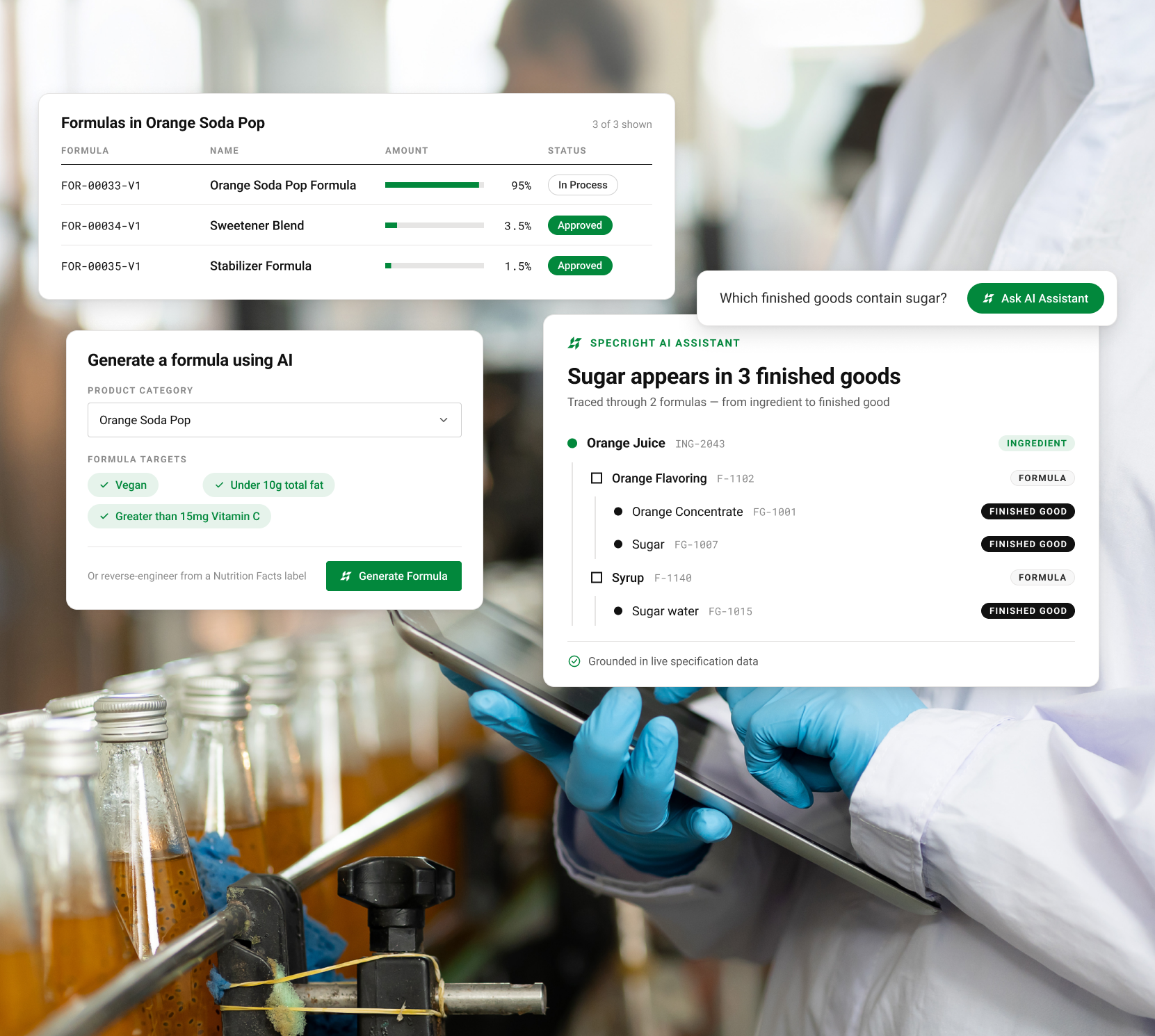
We launched R&D Workbench for Food & Beverage earlier this year for this exact reason: AI-powered formulation shouldn’t live apart from the spec data it depends on. It also means R&D doesn’t have to operate outside the circle of their regulatory, product development, and supply chain partners.
When a formula, an ingredient spec, and a nutrition label all trace back to the same connected data, “agentic” stops being a buzzword and becomes an operating model: a supplier updates a spec, and every formula, label, and BOM downstream reflects it.
What this means if you’re evaluating F&B PLM this year
If you’re in the market for F&B PLM, or reassessing what you already have, we feel Gartner framing is a useful gut-check question: is this a connected platform, or a set of fragmented tools presented as one? The distinction matters more now than it did a year ago, because the vendors that solved for connected data early are the ones positioned to make “AI-driven” and “agentic” more than a roadmap slide.
The question worth sitting with isn’t whether the market is heading this direction. It’s whether your PLM foundation is ready for it, or whether you’re still managing formulation and specs as two separate problems.
You can read the full Gartner report here or learn more about spec-first PLM.
Gartner, Market Overview for PLM Software in Food and Beverage Manufacturing, 19 August 2026 (ID G00851587).
GARTNER is a registered trademark and service mark of Gartner, Inc. and/or its affiliates in the U.S. and internationally and is used herein with permission. All rights reserved. Gartner does not endorse any vendor, product or service depicted in its research publications, and does not advise technology users to select only those vendors with the highest ratings or other designation. Gartner research publications consist of the opinions of Gartner’s research organization and should not be construed as statements of fact. Gartner disclaims all warranties, expressed or implied, with respect to this research, including any warranties of merchantability or fitness for a particular purpose.
-

Emily Powell
Emily Powell is Senior Director of Product Marketing at Specright, the AI-first platform for specification and product lifecycle management. She leads positioning and go-to-market strategy for Specright’s portfolio, helping CPG and manufacturing teams turn specifications into a competitive advantage. Emily brings a decade of SaaS GTM expertise to high-growth technology companies.
Explore More Blogs
-

Three Things Most Brands Get Wrong About Ecomodulation
Read More → : Three Things Most Brands Get Wrong About Ecomodulation -

Start With What You Know: What Sustainability in Packaging Europe Revealed About PPWR Compliance
Read More → : Start With What You Know: What Sustainability in Packaging Europe Revealed About PPWR Compliance -
Spec-First. AI-Powered. See It Live at Pack Expo 2026.
Read More → : Spec-First. AI-Powered. See It Live at Pack Expo 2026.



Get Started
With Specright’s Solution Suite, you can digitize, centralize, and link your specification data to drive efficiencies, intelligence, traceability, and collaboration within your organization and across your supply chain network.